Sunairio launches Emergency Event Forecasts to better anticipate power grid stress
More frequent extreme weather events, rapid load growth, and evolving generation mixes have made grid emergencies more common; Sunairio’s new offering allows market participants to anticipate those episodes in advance with greater precision.
BALTIMORE, MD. — October 22, 2026 —Sunairio, pioneer of next-generation grid forecasting software, today announced the launch of first-of-a-kind Emergency Event Forecasts: hourly probabilities of power grid emergencies — starting with the PJM and ERCOT regional transmission organizations (RTOs) — to help traders, asset managers, flexibility providers, and investors understand how to manage an increasingly strained system.
As extreme weather, rapid load growth, and shifting generation mixes push power grids to their operational limits, grid emergencies are moving from rare anomalies to frequent market drivers. Sunairio’s new forecasting capability equips market participants with probabilistic foresight to anticipate the tightest conditions hours, days, and even years in advance.
Navigating the "New Normal" of Grid Stress
When electricity generation reserves fall dangerously low relative to required levels set by NERC, grid operators declare an Energy Emergency Alert (EEA). These alerts can trigger sudden out-of-market interventions, manual load curtailments (brownouts or blackouts), and severe price spikes — with real-time energy prices often hitting or exceeding system offer caps.
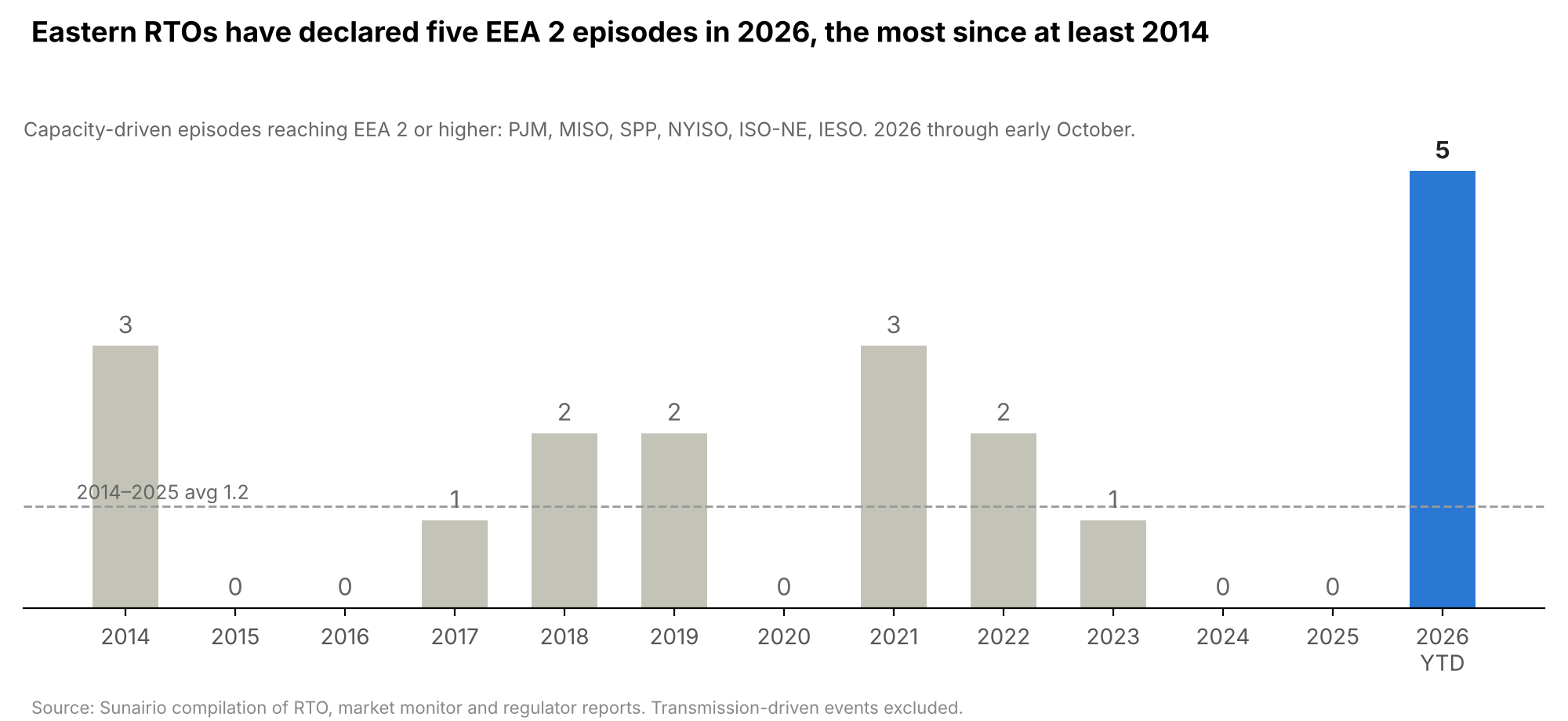
While reserve-shortage-driven EEA events used to be rare — averaging just one per year across the US’s Eastern Interconnection over the past decade — 2026 has marked a dramatic turning point. Already this year, Eastern RTOs have experienced five episodes requiring mandatory load management.
In PJM specifically, RTO-wide alerts were declared during record-setting summer heatwaves in July and again during autumn generator outage season in September and October. Each time, large industrial and data center customers were warned they could face direct disconnection from the grid.
Conventional market price and load forecasting models, which assume smoothly varying behavior, struggle to predict the sudden and extreme shifts that happen during grid emergencies. Sunairio’s Emergency Event Forecasts bridge this critical gap by predicting the exact conditions that trigger emergency declarations before they occur.
“Just last week, PJM experienced another grid emergency that triggered demand response, which was a surprise to many. But our models predicted that specific timeframe as having the highest expected grid stress risk in the entire quarter several months ago,” said Rob Cirincione, CEO of Sunairio.
Cirincione went on to share, "What we’ve witnessed across major power markets this year is a clear warning sign. As grid stress continues to intensify, providing clear, probabilistic visibility into these high-stakes hours gives power sector stakeholders the actionable foresight needed to ensure reliability, hedge financial exposure, and make smarter capital investments."
Powered by Sunairio’s Grid Stress Index and Sunairio ONE
At the core of Sunairio’s Emergency Event Forecasts is the company’s proprietary Grid Stress Index (GSI), which measures dispatchable capacity utilization — how much of the online dispatchable generation fleet is required to meet system load. During critical hours, GSI moves in lockstep with operating reserves.
Sunairio’s GSI forecasts are powered by the in-house Sunairio ONE ensemble, a next-generation forecast that specializes in replicating extreme events, generating 1,000 realistic hourly GSI forecast paths which are translated into precise, calibrated hourly probabilities (0–100%) for every level of the emergency ladder.
Tailored Solutions Across Energy Sector Stakeholders
Emergency Event Forecasts deliver critical operational and financial value across a wide range of industry players:
Data center and large load operators: assess local and system-wide curtailment risks, optimize site selection, evaluate backup generation needs, and value onsite capacity under proposed grid rules (such as PJM's IRAS framework)
Energy traders and independent power producers (IPPs): anticipate shortage pricing, size portfolio exposure to offer-cap price spikes, and position hedges ahead of extreme market events
Demand response (DR) aggregators and virtual power plants (VPPs): predict dispatch calls days in advance to ensure customer readiness and maximize performance incentives during emergency windows
Investors and asset managers: quantify long-term reliability risks and revenue potential across multi-year asset lifecycles extending out a decade into the future
Currently available for PJM and ERCOT, Sunairio’s Emergency Event Forecasts will soon expand to cover all US grid regions.
For a deeper dive on Sunairio’s newest tool and an analysis on recent grid emergency trends, read the technical blog post here.
To request a product demonstration or learn how Emergency Event Forecasts can be integrated into your workflow, contact the Sunairio team at info@sunairio.com or visit www.sunairio.com.
###
About Sunairio Sunairio is the pioneer of award-winning, next-generation grid forecasting software — the first forecasting platform to provide integrated energy, weather, climate, and market insights. Sunairio helps energy traders, grid operators, and asset managers make better commercial decisions in the face of increasing grid variability and extreme event risks. Sunairio and Sunairio ONE have received recognition from the National Science Foundation, American Clean Power, and EPRI. For more information, please visit sunairio.com.
After a Year of Grid Emergencies, a Way to See the Next One Coming: Introducing Emergency Event Forecasts
Every trader learns early on in their career that the year is made or lost in a handful of hours. Most days the grid is boring; the few days that aren’t can determine a year’s worth of P&L.
The important hours don’t occur randomly. The biggest price spikes, demand response calls, and moments when the ISO threatens to shed load happen in the hours when the grid is either in an emergency state or close to one. That's when operators are running out of reserves and the normal market rules stop applying.
What is an Energy Emergency Alert (EEA)?
When a grid operator, the balancing authority responsible for balancing load with supply, can't be sure it has enough generation to serve load and maintain required generation reserve levels, it declares an Energy Emergency Alert (EEA). These NERC-defined events, used by every balancing authority in North America, are summarized in Table 1 below. While EEA levels are defined in the NERC reliability standard EOP 011 (EOP-011-4), each grid operator enacts their own set of operating procedures to meet NERC’s standards.
Level
NERC definition
Where reserves stand
Market impact
EEA 1
All available generation resources in use
Operator is concerned about sustaining required contingency reserves
Prices rising toward the offer cap
EEA 2
Load management procedures in effect
Can no longer meet expected energy needs, but still holding minimum contingency reserves
Prices pinned to the offer cap (or beyond due to penalties and congestion)
EEA 3
Firm load interruption imminent or in progress
Unable to meet minimum contingency reserve requirements
Prices at or above cap. Administrative (human) intervention likely.
Table 1. Summary of NERC EEA levels, definitions, and market impacts
Before issuing the first official alert (EEA 1), each ISO also issues its own pre-emergency warnings, such as weather alerts and conservation appeals. These warnings are based on the grid operator’s early expectations of reserve levels and reflect the operator’s expectation that the grid is tightening.
If reserve level expectations shift even lower, operators issue progressively more serious EEA alerts as a function of the expected reserves and the NERC-mandated minimum reserve levels, culminating in the announcement of EEA 3 actions to manually shed load because the grid simply can no longer keep up with demand.
Increasing emergencies in the East
For most of the past decade, the most severe generation reserve emergencies barely occurred in the Eastern Interconnect. From 2014 through 2025, the six Eastern RTOs together averaged about one capacity-driven EEA 2 episode per year, with no events in 2024 and 2025.
2026 has been different. As of early October, Eastern RTOs have declared five EEA 2 episodes already – more than in any year since at least 2014 (Figure 1). MISO went to EEA 2 on January 24, July 15 and September 2; PJM declared EEA 2 on July 2–3 and again on September 17. Widely-published projections of generation reserve shortages by the end of the decade appear to have underestimated the degree to which the grid has already tightened.
Figure 1: EEA 2+ episodes per year, Eastern RTOs, 2014–2026 YTD. Source: Sunairio compilation of RTO, market monitor and regulator reports; transmission-driven events excluded.
That's why we're launching Emergency Event Forecasts: hourly probabilities of regional supply-scarcity-driven grid emergencies – starting with PJM and ERCOT – to help traders, asset managers, flexibility providers, and investors understand how to anticipate and manage this new normal.
Emergency event impacts on operations and market prices
Depending on the stakeholder, the impact of a grid emergency is most keenly felt through high market prices or the very-near possibility of load curtailment.
Data center operators. For large loads, a grid emergency is no longer someone else's problem. On July 2 this year, for example, PJM issued Back-Up Generator Warnings to large loads that they might be forced onto backup generation (i.e., disconnected from the grid). Under PJM's proposed Interim Resource Adequacy Service (IRAS), new loads of 50 MW or more that don't bring their own new capacity would be curtailed before PJM calls pre-emergency demand response. Although FERC rejected this proposal, it indicated that similar procedures could be instituted by state regulators.
Sunairio’s Emergency Event Forecasts responds directly to questions we've heard from data center operators, which no existing forecast yet answers:
How likely is curtailment at my site, this week and over the life of the asset?
Is the risk local to one zone or RTO-wide?
Does it hit one ISO at a time or several at once?
How does that risk change as the grid gets tighter?
Traders. For energy traders, a grid emergency sends the market immediately to a radically different price regime. Once an RTO is short on reserves, shortage pricing takes over, real-time prices pin at the offer cap, and congestion can push some nodes even higher. On September 2, 2026, for example, MISO hit its $10,000/MWh cap during an EEA 1 event. Traditional price forecasting algorithms, which anticipate a smooth curve, struggle with these volatile and discrete regime switches. An emergency event probability is a direct read on when that switch is likely to flip.
The emergency event ladder in PJM and ERCOT
As discussed previously, each ISO maps the NERC levels onto its own operating procedures, adding rungs before and within them. We’ve normalized these levels, starting with pre-emergency warnings (Table 2).
As the NERC definitions in Table 1 show, emergency declarations are fundamentally driven by anticipated reserve levels. In order to create forecasts of energy emergencies, we need to be able to accurately forecast reserve levels in the hours that matter.
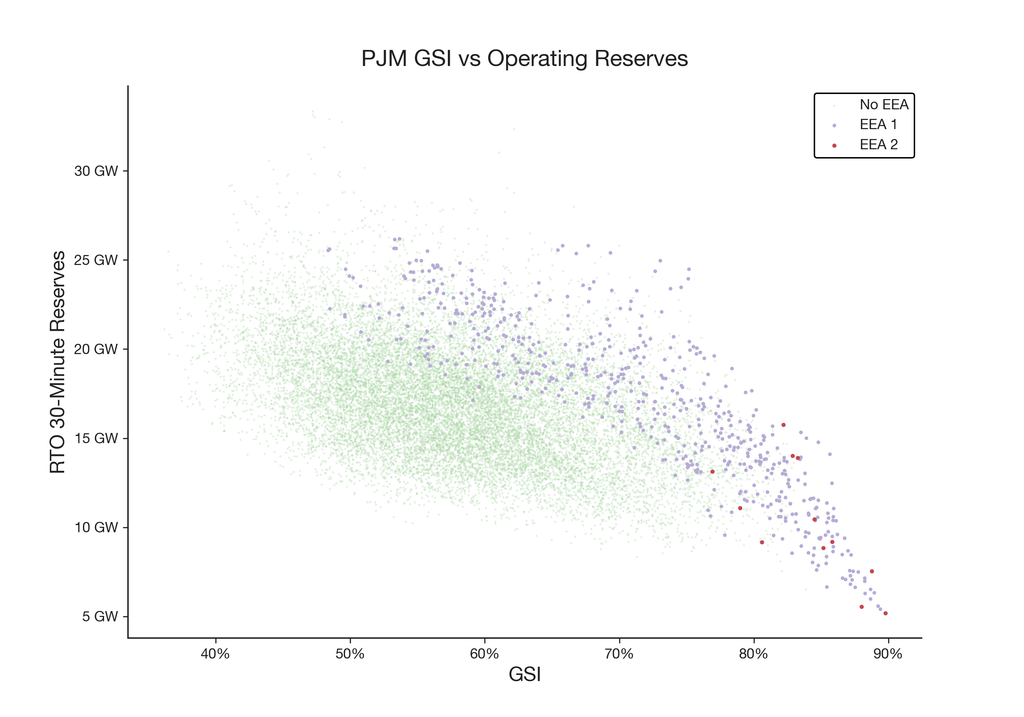
As we show in Figure 2, Sunairio’s proprietary Grid Stress Index (GSI) does this well – GSI is highly correlated to operating reserves in periods of high stress (with negative Pearson’s correlation, i.e. with reserves decreasing as GSI increases). As a reminder, GSI measures dispatchable capacity utilization: how much of the available dispatchable fleet is needed to serve load and is the signal that powers our hub price forecasts.
On ordinary days, GSI and operating reserves are less correlated (correlation = -0.47). Reserves move with unit commitment, imports, and operator choices that say little about system-wide stress. As the grid tightens, though, the relationship snaps into focus. And in the periods that lead to emergencies, GSI and reserves move almost in lockstep (correlation = -0.86).
Figure 2: In PJM, while GSI is loosely related to the RTO’s 30-Minute Reserves in general, this relationship is much stronger during times of grid stress (EEA 1 and EEA 2).
A signal that only works when the grid is tight might sound like a limitation, but in reality those are the only hours this forecast needs to get right – and the hours other approaches miss.
From grid stress to emergency event probability
Although their frequency is increasing, energy emergencies are still inherently rare. Even 5 daily events in a year across 6 Eastern ISOs only represents a 0.2% daily frequency. To tease out the occurrence of these rare events, our weather-driven ensemble produces 1,000 equally likely paths of hourly GSI for every load zone. We translate every path into a binary (yes/no) hourly forecast of each EEA level and then calculate the overall event likelihood based on the relative frequency within the 1,000-path ensemble.
As each balancing authority establishes their own operating procedures to meet NERC’s requirements, how we translate GSI to EEA events differs by ISO. In ERCOT, emergency levels are tied to explicit reserve thresholds. Therefore, our model follows that physical link. In PJM, on the other hand, operators have discretion over when to declare events. Here, we train machine learning models on PJM's history of emergency declarations in various grid conditions to learn how grid stress turns into actions.
Validation over summer 2026 in PJM
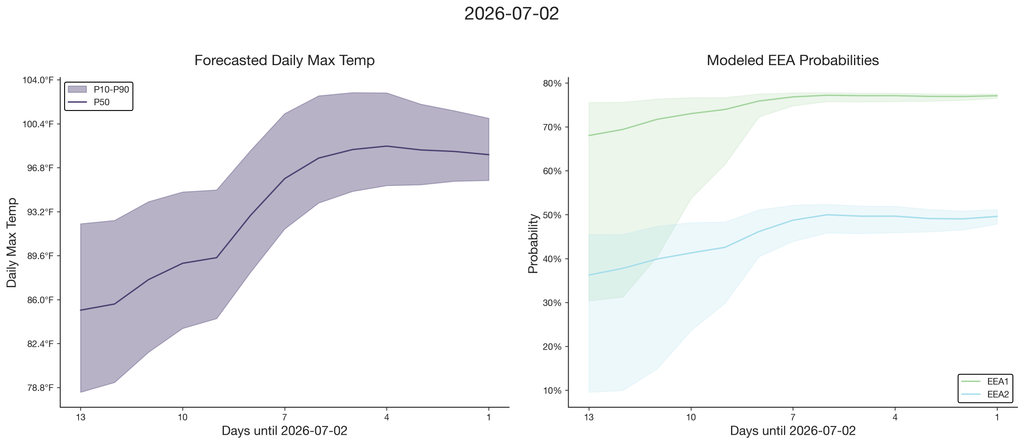
Our forecasts flagged a high likelihood of both of PJM's 2026 events several days in advance.
Figure 3: As weather forecasts identify the arrival of a record-setting heat wave in PJM, our Emergency Event Forecast identifies the increasing risk of EEA events a week in advance.
In the days leading up to July 2, weather forecasts identified a record-setting heat wave heading towards PJM. Load forecasts for the daily max soared above 165 GW, leading PJM to eventually declare an EEA 2 RTO-wide, activate emergency demand response, and issue a first-of-its-kind warning that large loads could be disconnected from grid power and forced onto backup generation (PJM). As we see in Figure 3, Sunairio’s Emergency Event Forecast identified the increasing risk of EEA 1 and EEA 2 events with increasing confidence a week in advance.
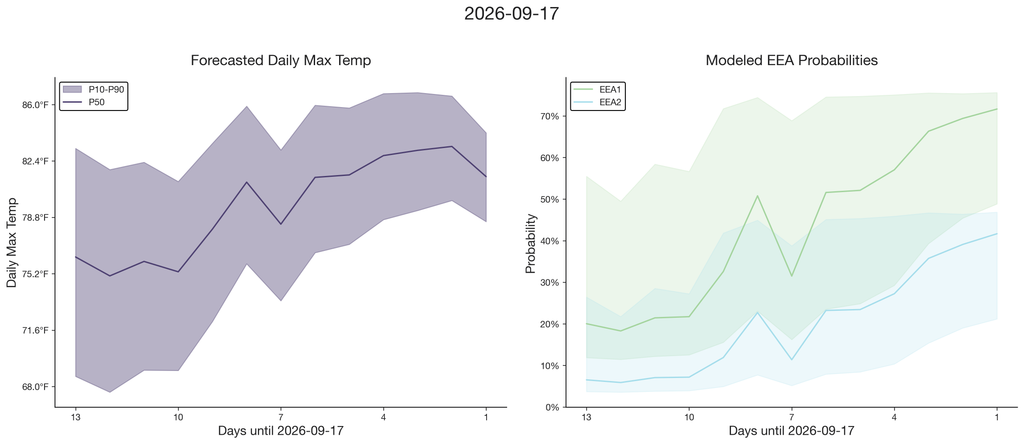
Figure 4: On September 17th, a late heat wave during outage season caused EEA events with relatively modest load. Sunairio’s Emergency Event Forecast takes outages into account and predicts increasing risks of EEA events as the date approaches.
In the days leading up to September 17, another heatwave headed towards the PJM footprint. This heat wave, though it brought milder temperatures than the July heat wave, coincided with generation maintenance and outage season in PJM. With 36 GW of generation offline (PJM) and a peak load forecast of 132 GW, PJM declared another EEA 2, pre-emergency demand response across most of the RTO, and emergency demand response in BGE, Pepco, and Dominion. As we see in Figure 4, our forecasts (which incorporate the effect of outages) predicted the increasing risk of EEA 1 and EEA 2 events well in advance of September 17.
And it gets tighter
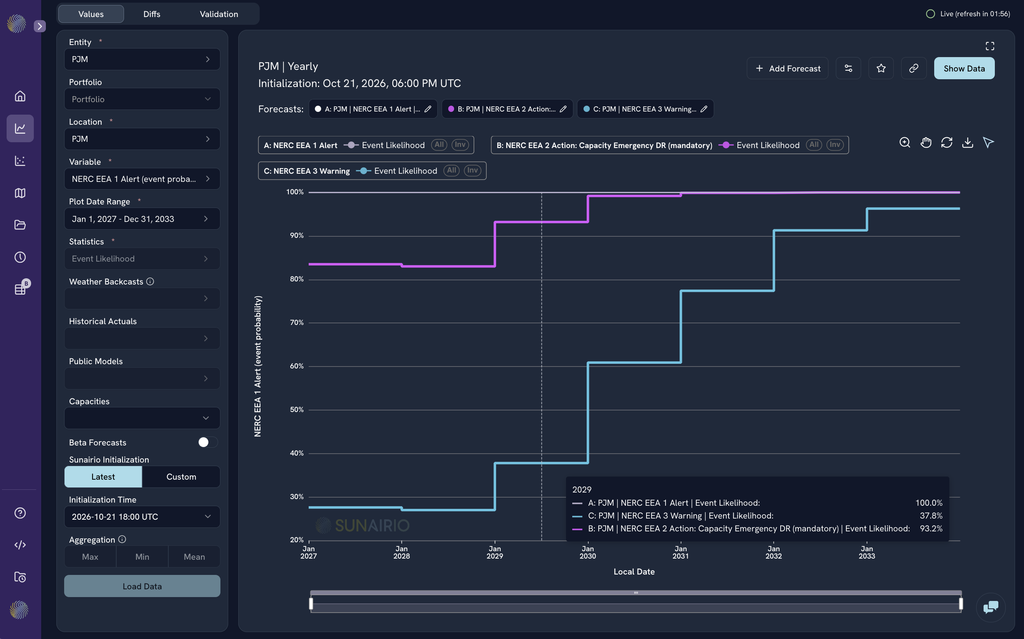
2026 isn't the tightest the grid will get. Our long-range forecasts show PJM emergency events increasing sharply after 2029 as load growth outpaces new supply. In Figure 5, we see that while we are nearly certain to have at least an EEA 1 event in each year, with the chances of having the more severe EEA 2 and EEA 3 events increasing as the grid tightens. Our models, for example, predict a 93.2% chance of an EEA 2 event and a 37.8% chance of an EEA 3 event in 2029.
Figure 5: Long-range forecasts of EEA events in PJM. As the grid tightens, the chance of an EEA event in each year goes up.
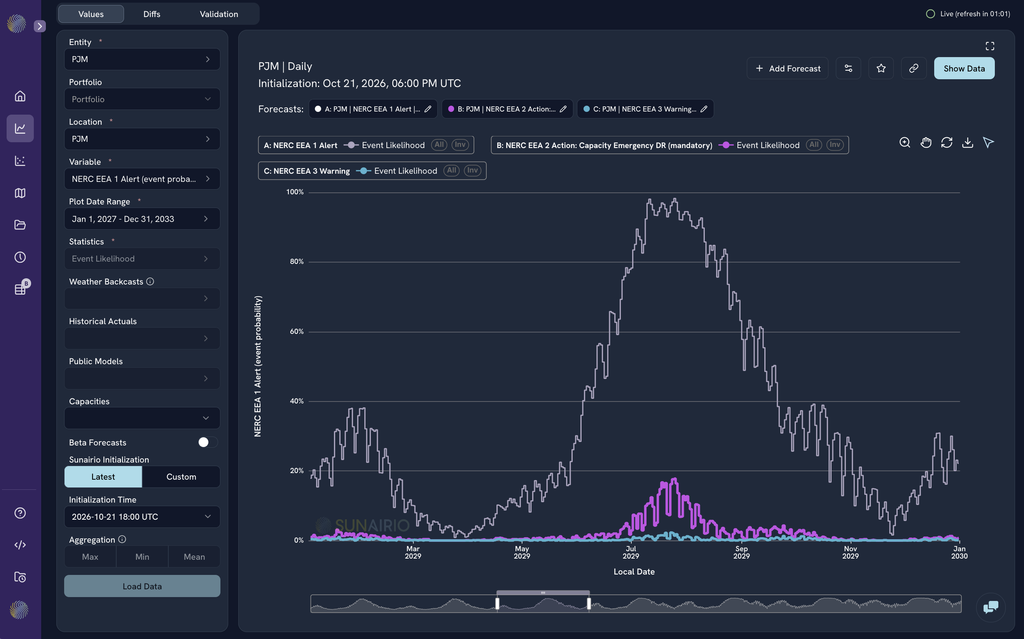
Zooming into the daily risk profile in 2029 (Figure 6), we see that the Emergency Event risk is primarily concentrated during weekdays in the summer, with some risk from winter storms and late summer heat waves that correspond with shoulder season outages.
Figure 6: Daily risk of EEA events, according to Sunairio models in 2029. The risk is concentrated in the peak summer months, though the occasional winter storm and heat wave during fall can also cause grid emergencies.
This is consistent with PJM's own outlook. The 2028/29 capacity auction cleared 6.8 GW short of the reliability requirement, and PJM expects system stress to rise through 2031 (POWER).
For a data center operator choosing a site, sizing backup generation, or weighing whether to bring its own capacity under potential IRAS-like regulations, this multi-year outlook of grid emergency risk is critical.
Emergency Event Forecast launch
Emergency Event Forecasts are available today in the Sunairio UI and through our API:
A probability (0–100%) for every step of an ISO's emergency ladder
Hourly, by load zone
From the next hour out to the next decade
Updated every hour
Available for PJM and ERCOT, with more ISOs coming soon
How customers use them:
Data center operators plan around curtailment and backup generation, compare sites, and value bringing their own capacity.
Traders and IPPs size their exposure to cap-level prices and position ahead of shortage events.
DR aggregators and VPPs anticipate dispatch and have resources ready.
The grid's worst hours used to be so rare that they were mostly ignored. They can’t be anymore. If your business depends on knowing when they're coming, contact us for a demo.
Sunairio Announces Grid Status Data Partnership to Streamline Power Trading and Grid Risk Mitigation
Energy market participants can now seamlessly track forecast performance, backtest strategies, and navigate grid volatility in one ecosystem.
Baltimore, Md. — July 28, 2026 —Sunairio, pioneer of next-generation grid forecasting software, today announced its newest data partner, power grid data and analytics firm Grid Status. Grid Status, which monitors the real-time status of the US electric grid, will now provide independent system operator (ISO) data for Sunairio’s forecasting platform, ensuring up-to-date, complete, and reliable data for critical decision making.
Thanks to the new partnership, Sunairio customers can now contextualize and validate Sunairio grid forecasts against official ISO data at scale within a single platform. This enables users to easily monitor energy forecast performance, perform trading strategy backtests, and investigate power market fundamentals through a single user interface and API.
The new capabilities provided by the partnership will better equip users to navigate an increasingly challenging weather and energy landscape. Today’s confluence of more frequent weather extremes, higher penetration of renewable energy, and increasing electricity demand have created the perfect storm for the power grid. Clear signals of power grid dynamics are vital for every company exposed to power market risk.
“Any serious forecast consumer needs high-volume and high-quality access to public forecast benchmarks and historical realizations in order to develop commercial strategies. Our new partnership with Grid Status allows Sunairo customers to do just that for all of our grid forecasts within ISO regions,” said Sunairio founder and CEO Rob Cirincione.
Cirincione went on to explain, “The importance of quality data to serve as ground truth really can’t be underestimated. Sunairio customers can now build end-to-end workflows that train, test, and validate strategies in a single platform that leverages a trusted ISO data provider. No more combining data from different sources, and no more worrying that the historical prices aren’t correct.”
Founded in 2020, Sunairio is the pioneer of award-winning, next-generation grid forecasting software that’s the first to provide integrated energy, weather, and climate insights. Sunairio helps energy traders, grid operators, utility-scale asset developers, and VPP and demand response aggregators make better commercial decisions in the face of increasing grid variability and extreme event risks. Sunairio and Sunairio ONE have received recognition from the NSF, ACP, and EPRI. For more information, please visit sunairio.com.
Fireworks Come Early: A Retrospective of the July 1-3 2026 Heat Event in PJM
In this post, we discuss the extreme weather, grid, and market dynamics that characterized the record July 4th week heatwave in PJM.
Temperature Extremes: Decent 5-day Forecasts, Near-Record Levels, Broad RTO Coverage
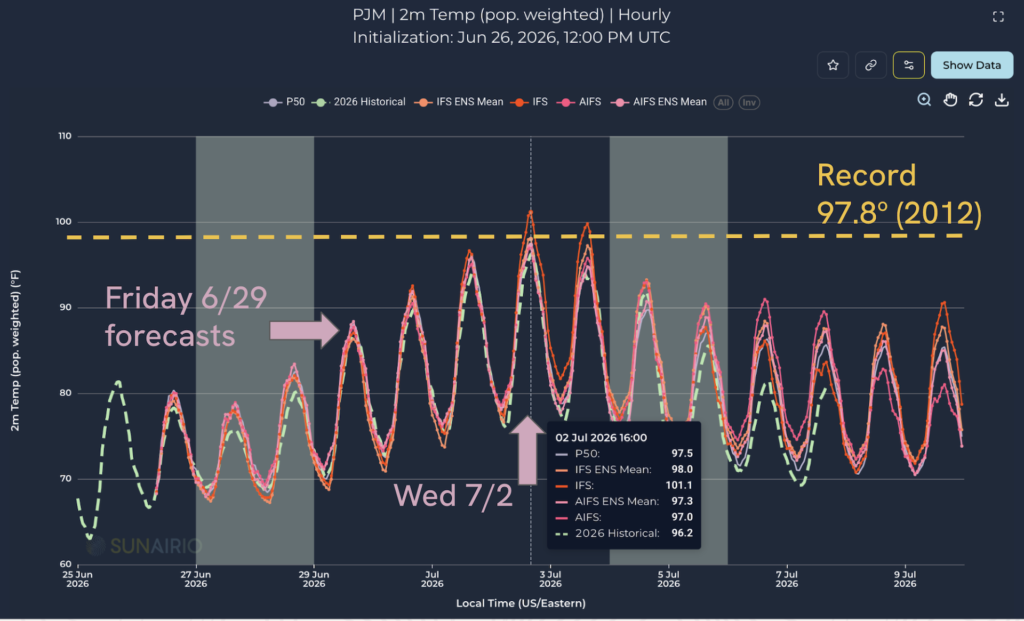
Similar to Winter Storm Fern earlier this year, most of the weather forecasts picked up on the extreme nature of this event about a week out. Figure 1 presents a screenshot from the Sunairio UI depicting PJM population-weighted temperature realizations and 15-day temperature forecasts from the IFS, IFS Ensemble mean, AIFS, the AIFS Ensemble mean, and Sunairio’s hourly P50 from Friday, June 26 12Z (the Friday prior to the event).
As the tooltip box within the plot shows, forecast expectations were generally very accurate (within a degree or so of realizations) for the July 1 to July 3 period, with the IFS being a bit of an outlier – more than 3 degrees too warm for the peak of the event on Wednesday July 2.
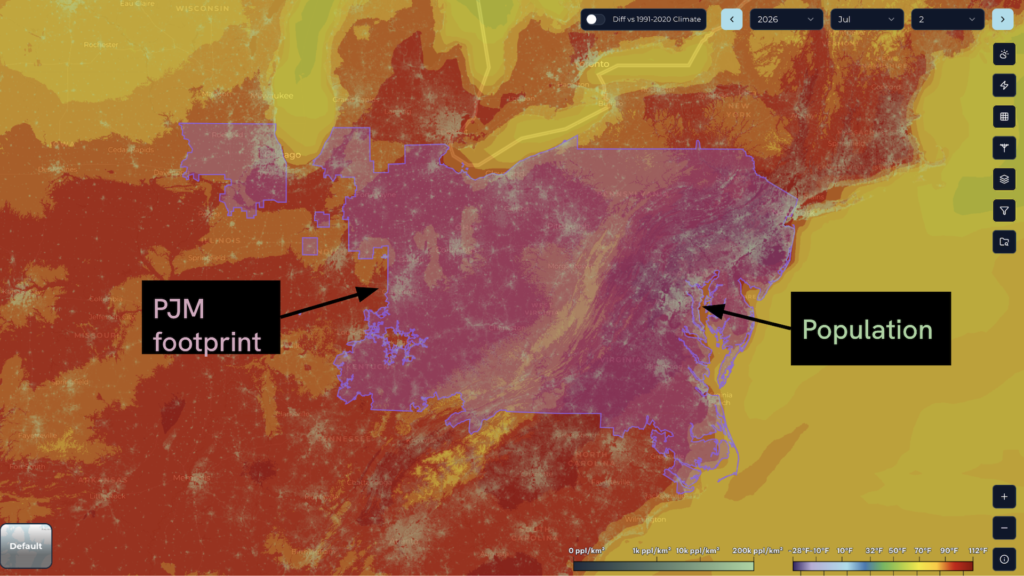
Note as well just how close this temperature index came to setting an all-time record for PJM, which is particularly impressive given how broad the PJM footprint is. As Figure 2 shows, the heat event on July 2 almost perfectly overlapped all population centers within PJM’s territory, driving demand to near-record levels as well.
Figure 1. 15-day hourly forecasts of PJM population-weighted temperature from the IFS, IFS ENS, AIFS, AIFS ENS, and Sunairio P50. Also shown are historical actual realizations and the all-time record for this weighted temperature index.
Figure 2. Sunairio High-resolution Earth Data (SHED) 2m daily max historical temperature contours for July 2, 2026. Also overlaid are the PJM RTO footprint boundary and high-resolution gridded population data.
Record Demand Levels and Critical Demand Response
The extreme heat drove zonal and RTO-wide generation to the highest levels we’ve seen in years, and approached all-time records on July 1 and July 2.
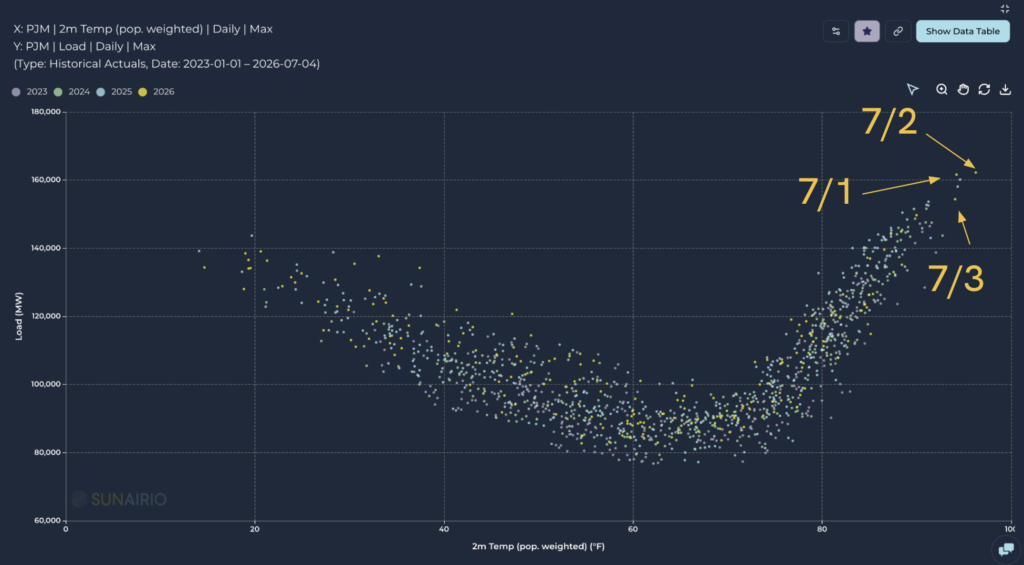
Figure 3 plots daily max population-weighted temperature versus daily max load since 2023. As the plot shows, cooling load in PJM (demand sensitivity to temperatures above 65 deg F) increases in an approximately linear fashion. Additionally, this heat wave produced three of the most extreme (“upper-right”) points.
In order to manage the associated extreme level of grid stress and ensure that generation reserves stayed above contingency requirements (basically ensuring that reserves are greater than the single largest potential unit trip), PJM activated various levels of Demand Response (DR) (120-min lead time, 60-min lead time, and 30-min lead time) throughout the day on July 2 and again on July 3. Note that PJM did NOT activate Demand Response on July 1 (more on this later).
Figure 3. Daily max PJM population-weighted temperature vs daily max PJM load, 2023-July 4, 2026
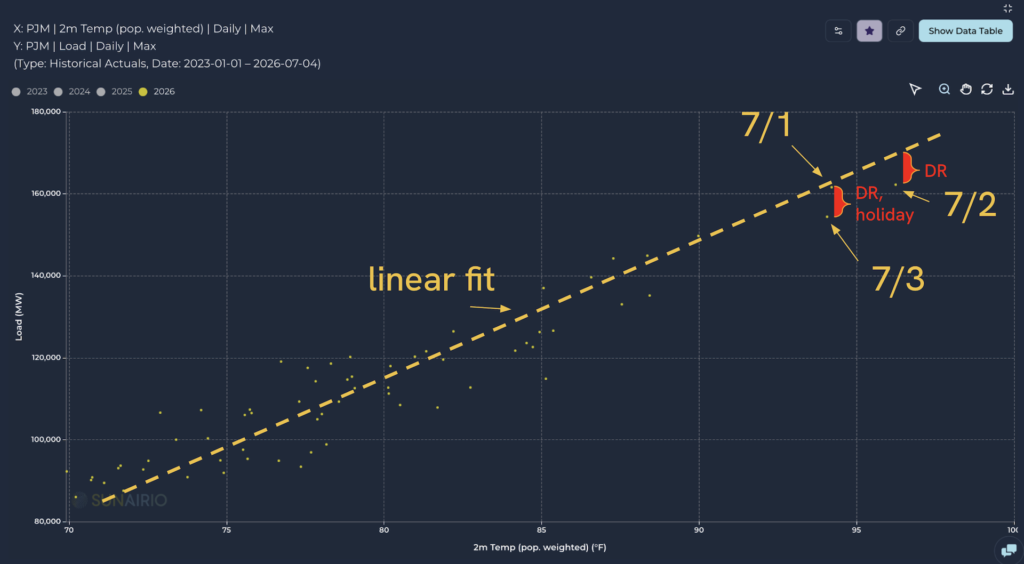
Zooming in on the cooling regime above 70 degrees and only plotting 2026 (Figure 4), we can clearly see that the linear relationship between temperature and load broke down on July 1 and 2 – but there was more than one demand-reducing dynamic to blame.
On July 2, the difference between the normal linear relationship and actual load is the effect of demand response and coincident peak shaving (commercial and industrial customers reducing their demand to lower their measured consumption in the anticipated ISO peak load interval, thereby lowering demand charges). On July 3, two factors contributed to lower demand: A) demand response/peak shaving and B) a holiday effect caused by the observance of July 4 (which fell on Saturday this year).
Regarding the magnitude of demand reduction actions on July 2 and July 3 – this chart alone implies that we observed approximately 5 GW of load reductions, and potentially up to about 7 GW on July 2.
Figure 4. Daily max temperature vs daily max load, 2026, and a linearly-fitted trend line. July 1-3 are shown along with the approximate reductions due to demand response, peak shaving, and holiday effects.
NERC Emergencies, RT Price Maximums, and a Threat to Data Centers
As the day wore on during the July 2 afternoon, reserves continued to fall in PJM even though all DR programs had been activated and real-time (RT) prices approached the $2,000/MWh offer cap. With no more market-based solutions available, PJM issued a NERC EEA 2 emergency at 5:00 PM for the entire system, indicating that reserve levels were likely to fall below required minimum levels without extraordinary interventions.
Over the next hour, PJM issued two of these extraordinary directives. At 5:32, the ISO warned of the “potential need to direct Large Loads to operate on Back-up Generation,” effectively warning any data center with backup generation that it was about to be disconnected from the grid. Although PJM did not follow up with the actual disconnect order, this is the closest the ISO has come to initiating this new emergency measure – first requested (and granted by DOE) before Winter Storm Fern.
Minutes later at 5:36 PM, PJM issued a “Deploy All Resources Action,” which ordered all generators to operate at Emergency Maximum levels.
At this point, RT prices had climbed well above $2,000 in the Mid-Atlantic sub-region.
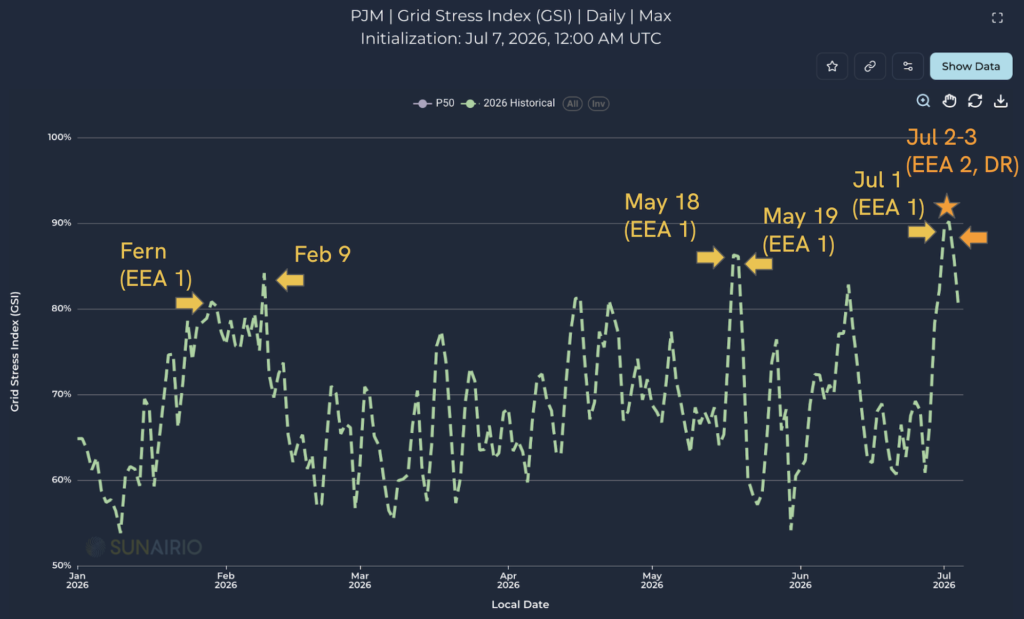
Turning to Figure 5, we can see exactly how severe the conditions were by plotting Sunairio’s Grid Stress IndexTM, our proprietary measure of dispatchable capacity utilization, for 2026 year-to-date. As the plot of daily maximum GSI shows, July 1-3 were the tightest days on the grid in 2026, exceeding levels seen during Fern, the cold snap on February 9, and the EEA 1 alert days on May 18-19.
Curiously though, we recorded a lower overall maximum GSI level on July 3 (86.2%) vs July 1 (89.4%) even though PJM operated as if July 3 was tighter – issuing an EEA 2 emergency and activating DR.
We believe these actions can be partly explained by conservative human behavior in the control room. That is, we hypothesize that grid operators erred on the side of caution on Friday July 3 after seeing just how close the system came to reserve level violations on Thursday July 2. Moreover, the operators may have worried that any call to action (such as demand response) would yield less participation on Friday compared to Thursday given the observed holiday.
Figure 5. Daily max Grid Stress IndexTM for January 1 - July 4, 2026.
Extreme Price Risk Captured by Sunairio ONE
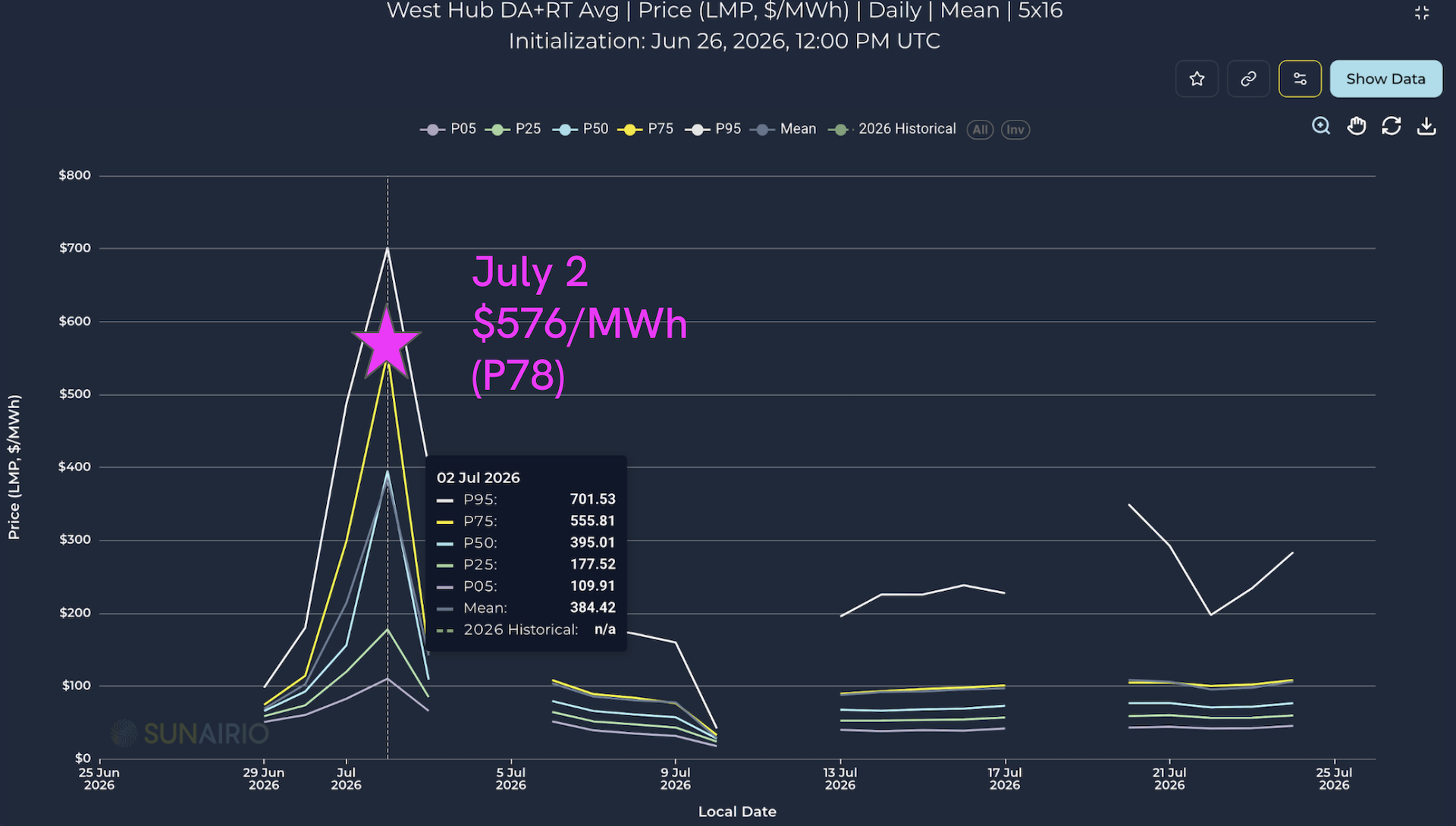
Putting this all together, we return to the Friday before the event (June 29) to examine how well Sunairio’s PJM price forecast captured this market risk. As Figure 6 shows, Sunairio did an excellent job of highlighting the massive market upside (here plotting the average of DA and RT Western Hub) centered on July 2.
Figure 6. Sunairio forecast of Western Hub Daily 5x16 prices, initialized June 29 12 Z. The July 2 extreme event realized at P78 of our forecast.
Conclusions
The July 1-3 2026 heat wave was reasonably well forecasted by most weather models 5 days out.
Realized temperatures soared across the PJM RTO footprint, coming within 1 degree of all-time records.
PJM activated Demand Response and issued the first widespread grid emergency (NERC EEA 2) since Winter Storm Elliott.
We observe approximately 5-7 GW of demand reduction on July 2 and July 3, encompassing DR actions and coincident peak shaving.
Sunairio’s probabilistic price forecast did an excellent job of anticipating the extreme market outcomes – faithfully predicting the upside-skewed distribution for Western Hub prices, which realized at P78 of Sunairio’s forecast from 5 days out.
From API to UI: Cracking the Code on ISO Trading Hub Price Forecasting
This week, Sunairio is officially launching our Trading Hub Price Forecast Ensemble directly in the Sunairio User Interface (first in ERCOT, other ISO regions to follow soon).
For a while now, customers have used our price forecasts via API to quantify market risk. By moving this capability into the UI, we’re making a truly probabilistic, fundamentals-driven view of ISO power prices significantly more accessible — no code required.
To mark the occasion, we want to lift the hood on our methodology and share how we cracked the code on modeling highly non-linear energy prices—even in the notoriously volatile gas basis markets of the Northeast US.
A Quick Refresher: The Grid Stress Index (GSI)
You can't accurately forecast power market prices without understanding the underlying physical reality of the grid. Traditional price models try to track this by building massive, unit-by-unit generation stacks. But in a modern grid dominated by variable renewables and unpredictable weather, that traditional approach breaks down.
Our solution is the Grid Stress Index (GSI)TM, a proprietary measure of Dispatchable Capacity Utilization (DCU). Instead of tracking thousands of individual power plants, we compress the entire grid’s supply-and-demand tension into a single, elegant metric in percentage space:
This is fundamentally a relationship between [the energy that needs to be supplied by dispatchable capacity] to [the amount of dispatchable capacity available to generate].
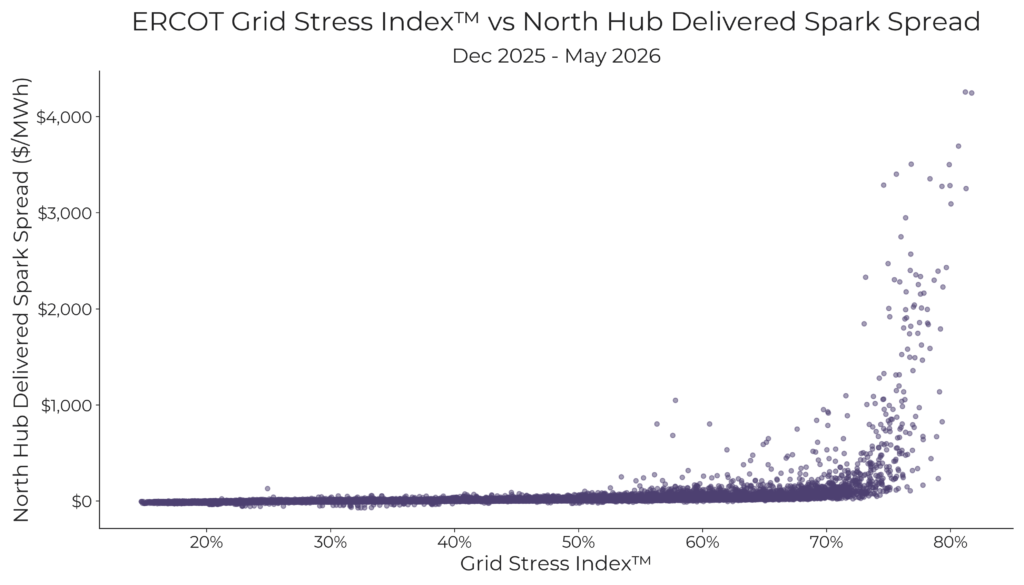
By mapping GSI to Delivered Spark Spreads (using a standard 6.5 HR to filter out commodity fuel noise), we uncover the true, empirical supply curve of a market, as seen in Figure 1.
Figure 1 plots GSI vs delivered North Hub delivered spark spreads in ERCOT for Dec 2025 - May 2026. What we observe is a learned market supply curve that reflects the enormously skewed behavior of most power markets: relatively controlled increases in price for much of the supply-demand regime, followed by extreme increase after an inflection point (about GSI = 75% in ERCOT).
Figure 1. The relationship between grid stress and power market prices
How the Sunairio Fundamental Price Model Works
Unlocking the relationship between grid stress and spark spreads was only step one.
Translating that relationship into highly accurate, hourly forward prices requires a clever mathematical approach. Here is how the Sunairio Fundamental Price Model operates under the hood.
1. Handling DA and RT Prices as a DA+RT Average
There are significant differences in the way that the DA market is solved compared to the RT market. For example, the RT market is fundamentally physical (physical supply must match physical demand), while the DA market is essentially a financial construct. Moreover, the DA energy market doesn’t even utilize a load forecast – it clears supply offers against demand bids.
Power markets also utilize specific products known as virtuals (virtual supply and virtual demand) that work as a converging force to drive DA and RT prices together. Over the long term, the spread between DA and RT prices is exceptionally low in most power markets, though hourly and daily spreads can be quite wide.
Given the difficulty of fully reconstructing the DA market inputs (you would have to know demand bids and exact virtuals participation), and the existence of virtuals as a converging force, Sunairio doesn’t model the DA and RT markets separately. Instead we model an average of DA and RT prices, which represent the overall economic balance for that day.
2. Temporal Bucketing
Power markets behave differently depending on the clock and the calendar. The grid dynamics of a Tuesday afternoon are vastly different from a Sunday morning – driven by both the hourly/daily cycle of demand and the physical constraints (like ramp rates and minimum run times) of many thermal generators.
For example, units with high startup costs or long minimum run times may self-schedule themselves overnight (essentially offering the plant as a market-price taker with $0 marginal cost rather than an economic resource at actual marginal costs) in order to more effectively compete for the prime daytime peak prices the next day. This means the overnight (7x8) stack is different from the weekday peak (5x16) stack.
To capture these operational nuances, we segment our historical grid data into distinct time buckets:
5x16 (Weekday peak)
2x16h (Weekend peak and holidays)
7x8 (Off-peak/night)
3. Outage Regime Bucketing
The Grid Stress Index is dependent on knowing the amount of dispatchable generation offline. While we can never know with 100% certainty exactly what units will be unavailable in the future, Sunairio has built highly accurate outage forecasts that can predict the aggregate amount of MW offline.
The challenge is that not all generation outages are made the same. Removing 100 MW of baseload power from the generation stack could affect every hour’s price (by forcing the grid operator to dispatch more expensive units to meet baseload demand), while removing 100 MW of a peaker might not affect anything if demand doesn’t rise high enough.
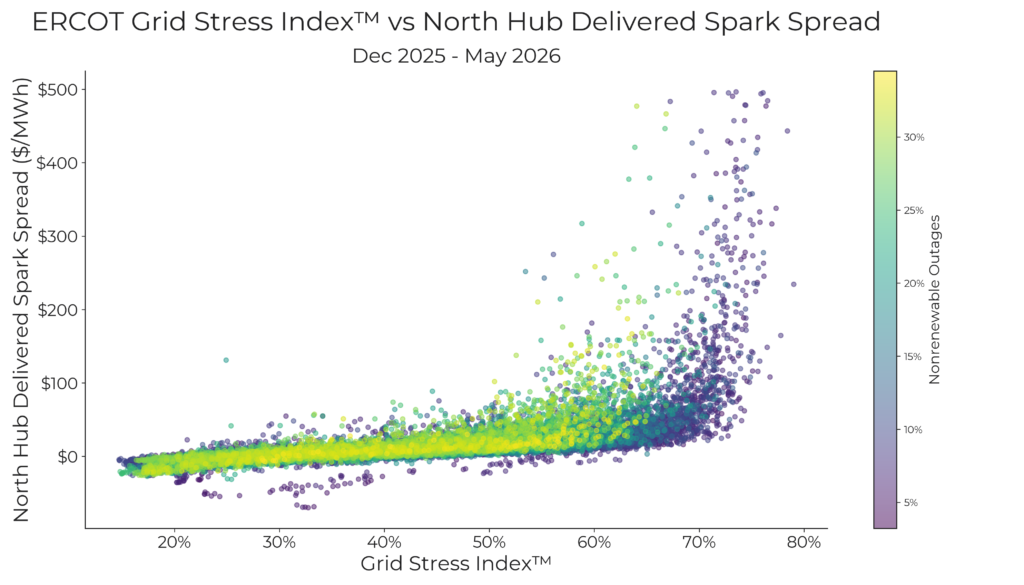
We can clearly observe this dynamic in the plot below, which colors the GSI vs spark spread plot for ERCOT according to the percentage of dispatchable units offline. As Figure 2 shows, the inflection point in the empirical market supply curve is shifted left (occurs at lower levels of apparent GSI) when total nonrenewable outages are greater than 25% of installed nonrenewable capacity.
Figure 2. The effect of nonrenewable (thermal) generation outages on the relationship between GSI and delivered spark spreads
4. Emulating the Stack via Isotonic Regression
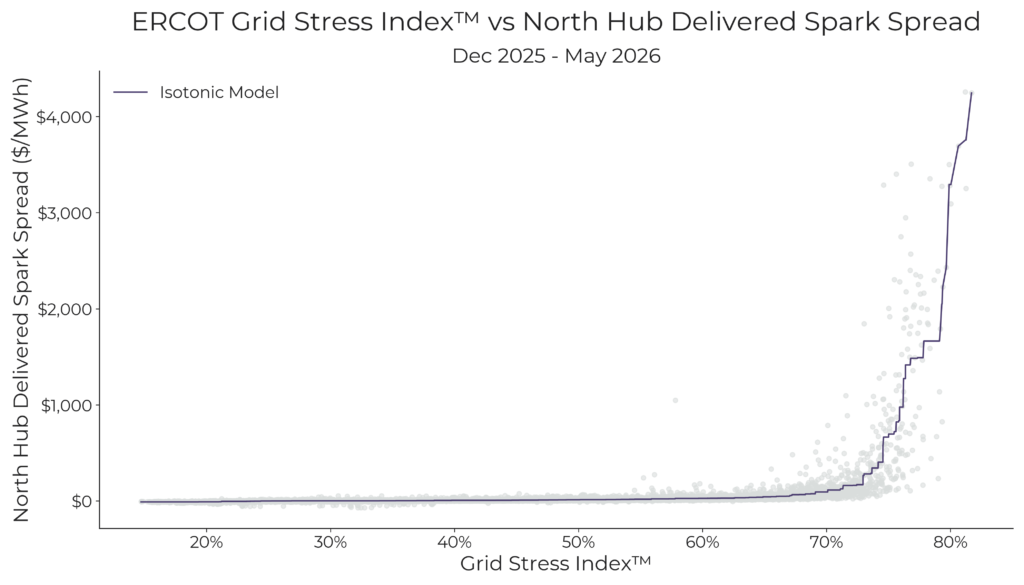
Once the data is bucketed, we fit the GSI vs. Spark Spread relationship using Isotonic Regression.
Unlike standard linear regressions that force a smooth line through data points, isotonic regression specifies only one constraint: the function must be non-decreasing. This mathematical choice yields an extraordinary side effect—it naturally produces step-wise models.
Figure 3. Using isotonic regression to construct an empirical power market supply curve
Because physical grid operators dispatch generators in blocks of capacity from lowest to highest marginal cost, the true supply curve is literally a staircase. Isotonic regression allows our model to learn the physical supply stack empirically from market behavior, without us having to model individual power plant heat rates or fuel contracts.
5. The PJM Paradox: Solving the "Messy Blob"
In a market like ERCOT, mapping GSI to spark spreads with time buckets generally gets the job done beautifully. But when we applied this exact framework to Northeast markets like PJM, we ran into a wall.
When you plot Western Hub LMPs against local northeast gas prices using a standard 6.5 heat rate, the data doesn't look like a nice hockey stick. It looks like a messy, unreadable blob. There appeared to be no relationship between grid stress and spark spreads.
The breakthrough came when we realized that in the Northeast, extreme fuel price variations don't just shift the cost of power—they fundamentally alter market bidding behavior. To fix this, we introduced Fuel Price Regimes.
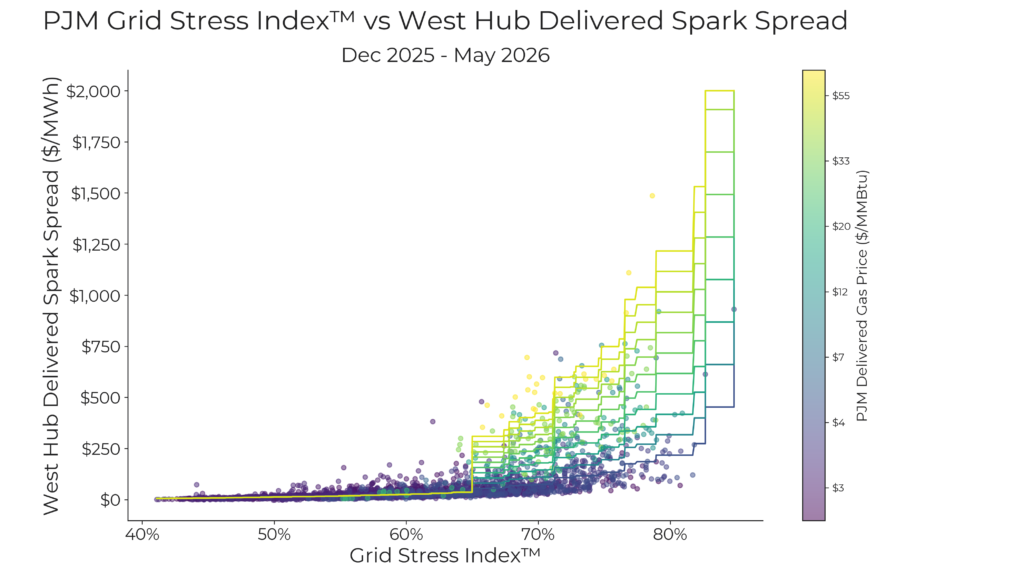
We segmented the PJM data by delivered gas price bands. When you filter the data through these regimes, the magic happens: the blob vanishes, and distinct, beautifully defined curves emerge.
Fuel Price Regime
Observed Market Behavior
Impact on Curve
Low Gas
Abundant cheap fuel; flat bidding behavior.
Flatter, lower inflection point.
Moderate Gas
Standard economic dispatch behavior.
Moderate, predictable "hockey stick."
High Gas
High opportunity costs; aggressive scarcity bidding.
Steeper, highly aggressive price acceleration.
When gas prices are high, generator bidding behavior becomes significantly more aggressive for the exact same level of physical grid stress. By building separate isotonic regressions for both different time buckets, outage regimes, and fuel price regimes, our model successfully masters the complexity of PJM and the Northeast.
Figure 4. Modified empirical market supply curves according to local delivered natural gas prices
6. Running the 1,000-Path Hourly Ensemble
With our mathematical curves established, we feed the model our probabilistic inputs: Sunairio ONE’s 1,000-path hourly GSI ensemble.
Because our weather-driven ensemble correctly forecasts thousands of fully correlated scenarios—perfectly capturing the joint probabilities of a heatwave, low wind speeds, and forced thermal outages—passing those GSI paths through our price regressions yields a true, mathematically rigorous probability distribution of hourly energy prices.
Conclusions
Empirical Supply Stacks: By utilizing isotonic regression, Sunairio's price model naturally replicates the step-wise nature of a physical dispatch stack without the data burden of traditional unit modeling.
Fuel Price Conditioning: In volatile markets like PJM, looking at grid stress alone isn't enough. Sunairio isolates distinct market behaviors by segmenting forecasts into specific fuel price regimes.
True Probabilistic Pricing: Power price risk lives in the tails. By pairing our fundamental price model with our 1,000-path weather ensemble, we provide users with a clear view of the frequency, duration, and severity of potential price spikes.
Now in the UI: Beginning now, users no longer need code to access these insights. The full power of our trading hub price forecast ensemble can be completely visualized and interactive right inside the Sunairio platform.
Sunairio Launches Asset-Level Generation Potential Forecasts to Fill Data Gap for Energy Traders & Grid Planners
By reconciling high-resolution weather ensembles with asset-specific Digital Twins, Sunairio provides the missing data needed to quantify curtailment, congestion, and basis risk across the grid, for thousands of utility-scale wind and solar farms throughout the US.
Baltimore, MD. — March 26, 2026 —Sunairio, pioneer of next-generation grid forecasting software, today announced the launch of its hourly Asset-Level Generation Potential Forecasts. This new capability provides hourly predictions for every utility-scale wind and solar farm across major power market regions, beginning with ERCOT.
Asset-level Generation Potential forecasts provide the high-fidelity visibility required to navigate the ever-evolving grid, helping to quantify the supply-side volatility that drives congestion, curtailment, and basis risk in modern power markets.
Sunairio generation potential forecasts differ from traditional regional wind and solar generation forecasts in two important ways:
They provide individual energy forecasts for every utility-scale project — not just regional aggregations — allowing users to anticipate local variability down to the nodal level.
They forecast potential generation compared to traditional renewable forecasts that are designed to forecast actual generation after curtailment.
By forecasting weather-driven potential generation, rather than post-curtailment energy, Sunairio Asset-Level Generation Potential Forecasts can be used as high-quality inputs for power flow and trading models. Traditional as-generated renewables data, on the other hand, can’t be easily used to model the grid because they represent a curtailed solution of the grid operator’s dispatch model, not an input to it.
"Trying to anticipate transmission congestion with traditional renewables forecasts is essentially guesswork to find the missing MWs," said Rob Cirincione, CEO, Sunairio. "Our Asset-Level Generation Potential Forecasts isolate the weather-driven energy potential from grid-enforced physical limits, allowing users to quantify the volume of energy at risk of curtailment before it happens."
The forecasts are powered by two proprietary Sunairio technologies:
Sunairio Digital Twins: High-fidelity, physics-based models of over 1,400 wind farms and 7,500 solar farms.
Sunairio ONE: A high-resolution weather forecast ensemble that provides the hyperlocal inputs necessary to drive the Digital Twins.
The launch of Asset-Level Generation Potential Forecasts provides critical, nodal-specific insights for a variety of stakeholders navigating today's increasingly complex power markets:
For nodal traders: By aligning generation potential with historical nodal price data, traders can predict the likelihood of nodal congestion.
For hub traders: Zonal generation potential aggregations reveal macro signals that drive zonal basis spreads. This signal is completely obscured in actual (post-curtailed) generation data.
For grid planners: The data serves as a high-precision input for production cost modeling, helping grid planners identify the exact transmission infrastructure needed to realize specific volumes of weather-driven energy potential.
Sunairio ONE represents a shift from reactive grid observation to predictive, physics-based intelligence. For more information, please visit sunairio.com or email info@sunairio.com.
###
About Sunairio Founded in 2020, Sunairio is the pioneer of award-winning, next-generation grid forecasting software that’s the first to provide integrated energy, weather, and climate insights. Sunairio helps energy traders, grid operators, utility-scale asset developers, and VPP and demand response aggregators make better commercial decisions in the face of increasing grid variability and extreme event risks. Sunairio and Sunairio ONE have received recognition from the NSF, ACP, and EPRI. For more information, please visit sunairio.com.
Media Contact Logan Varsano, Inflection Point Agency for Sunairio logan@inflectionpointagency.com
The Pure Meteorological Signal: Launching Sunairio Asset-Level Generation Potential Forecasts
Generation Potential: The Pure Meteorological Signal
Forecasting the weather-driven energy production of wind and solar farms is critical for understanding the physical impact renewable generators have on the grid: variable power flow dynamics, regional supply-demand balances, and ultimately economic price risk. Yet the renewable generation data that’s typically been available to forecasters and grid modelers has a fundamental flaw: it’s reported after curtailment. That is, when historical renewable generation data is provided from public sources, those data sets report as-generated values that include losses due to curtailment (caused by transmission congestion that limits renewable output).
This means that forecasts designed to predict actual renewable generation are missing the most important piece of the story: the potential generation that could have been produced if not for the congestion – i.e., the true meteorological signal of renewable generation risk.
Today Sunairio is excited to fill this gap by launching hourly Asset-Level Generation Potential Forecasts for every utility-scale wind and solar farm across major ISO power markets, beginning with ERCOT. By combining high-resolution Sunairio ONE weather forecast ensembles with high-fidelity wind and solar farm Sunairio Digital Twins, Asset-level Generation Potential Forecasts provide the purest signal of variable generation-driven price volatility on the grid – from individual generator nodes all the way up to ISO-level aggregates and trading hubs.
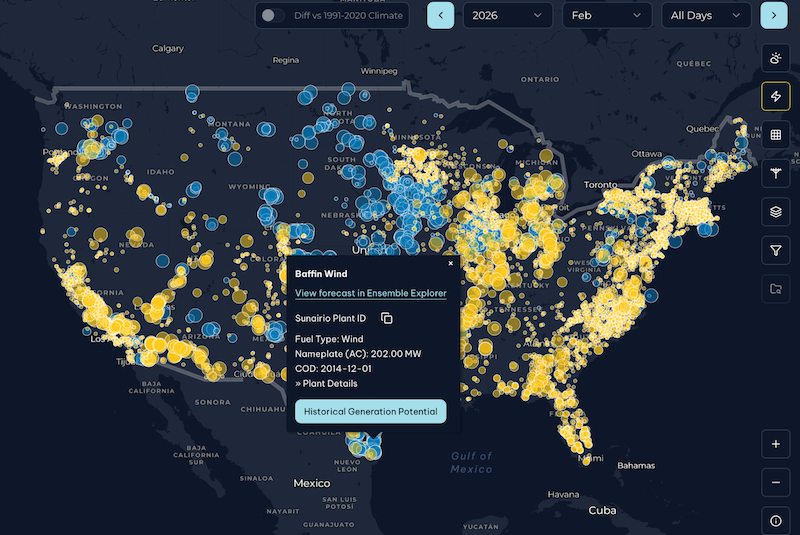
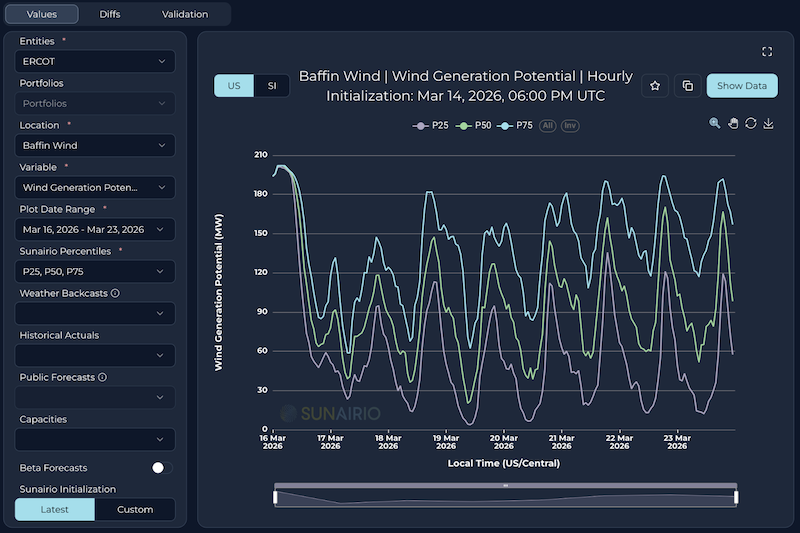
Figure 1 provides a sneak peak of what this feature looks like in our platform.
Figure 1. (Left) Map of solar and wind assets in the Sunairio Maps module; (Right) Example wind asset forecast shown in Sunairio Ensemble Explorer module.
Why it Matters: The Unseen MWs that Actually Drive Congestion
The as-generated energy vs. generation potential nuance creates a vexxing problem for anyone trying to understand power market fundamentals. First, it means that we can’t try to replicate past market outcomes by simply using as-generated wind and solar values as inputs to engineering models of the grid – because that actual generation was potentially a curtailedsolution of the balancing authority’s dispatch model, not an input to it. Moreover, it means we can’t easily distinguish between A) an hour that had low renewable generation because the wind/solar resource was low and B) an hour that had low renewable generation because the wind/solar resource was so high that it was curtailed due to congestion.
Trying to triangulate the curtailment signal from LMP or raw weather is messy and difficult given the often non-linear relationship between weather and renewable generation. The fundamental signal we want is straightforward: weather-driven hourly renewable generation before curtailment.
How We Do It: Sunairio ONE + Sunairio Digital Twins
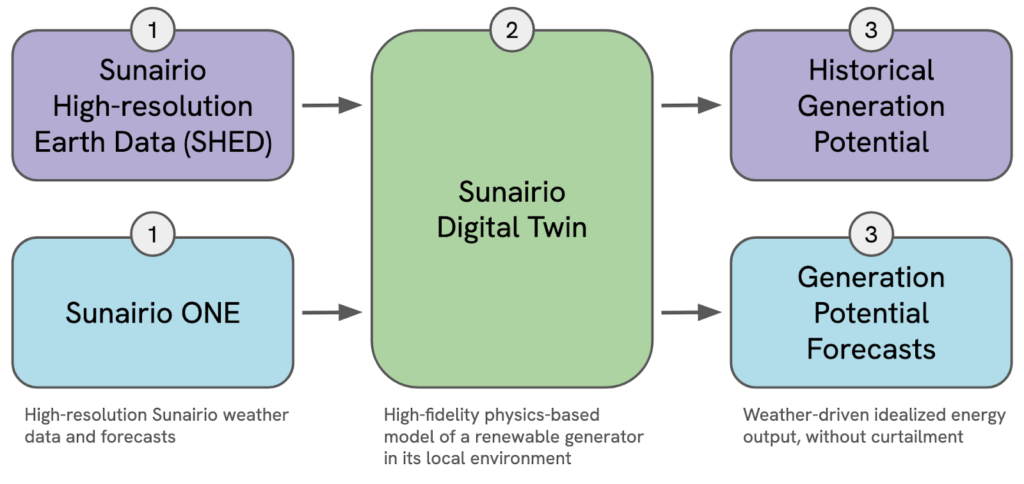
Creating Generation Potential starts with building a Sunairio Digital Twin – a high-fidelity physics-based model – of each asset. Sunairio Digital Twins incorporate plant-level technical characteristics (turbine coordinates, hub heights, power curves, PV tracking, PV panel efficiency, etc.) in addition to hyperlocal terrain modeling. For wind, this includes running a 100m-resolution CFD model over the farm footprint to translate mesoscale (3km) wind speed averages into 100m-resolution turbine-scale wind speed fields, and then factoring in turbine-by-turbine waking. For solar, we leverage the best-in-class PVLIB solar modeling suite to replicate asset-specific generation characteristics. These Sunairio Digital Twins already support our existing Historical Generation Potential dataset – covering more than 1,400 utility-scale wind farms and 7,500 utility-scale solar farms – and leverage our market-leading Sunairio High-Resolution Earth Data (SHED) as the source for historical weather.
With the development of Sunairio ONE, we’re now able to provide Generation Potential forecasts, in addition to historical Generation Potential, for all of these renewable sites (Figure 2). By isolating the weather-driven potential from the grid-enforced transmission limits, we enable our users to quantify the volume of energy at risk of curtailment before it happens – and identify high-conviction nodal arbitrage opportunities that post-curtailment forecasts overlook.
Figure 2. Process of creating Generation Potential given weather inputs and Sunairio Digital Twin model of a wind or solar asset.
Performance: Accuracy Where It Matters
We validated our Asset-Level Generation Potential Forecasts against data from IPP partners to confirm how they perform in real-world conditions. For this analysis, we limited our scope to sites that could provide a complete generation picture: hourly availability, hourly curtailment, and hourly net generation. By accounting for availability and adding back curtailment MW we’re able to validate our generation potential forecasts on an apples-to-apples basis.
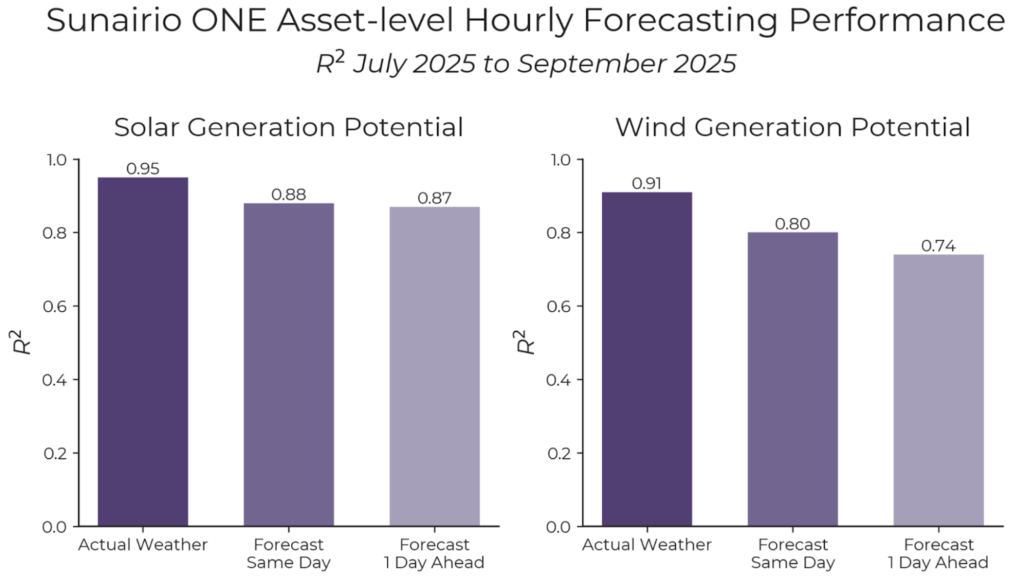
On a portfolio of three solar sites and six wind sites, Sunairio’s forecast of Generation Potential using same-day and day-ahead weather forecasts achieved scores similar to that of using historical actual weather (Figure 3).
Figure 3. Forecast validation results for a solar portfolio and wind portfolio over three months.
For Nodal Traders: The "Electric Peninsula" Case Study
An analysis of the coastal wind farm cluster near the Ajo substation in ERCOT South demonstrates the impact of renewable generation on transmission congestion and highlights the value of Sunairio Generation Potential forecasts for nodal trading.
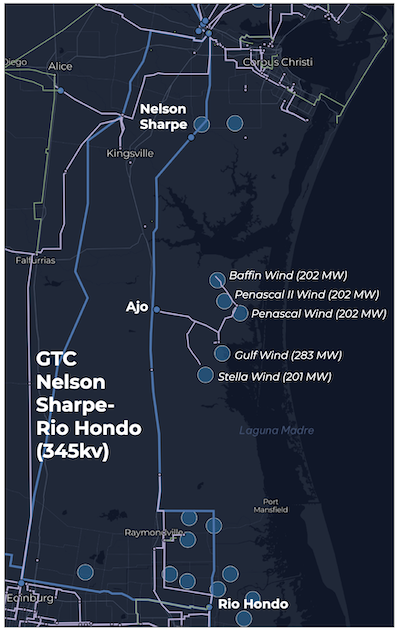
As shown in Figure 5, five wind farms totaling more than 1,000 MW compete for transmission capacity on the lone path off the coast: the Nelson Sharpe - Rio Hondo line. The Nelson Sharpe - Rio HondoGeneric Transmission Constraint (or NELRIO GTC) in Kennedy County, TX is a notorious bottleneck that ranked as the third most frequently binding constraint in 2025 (Potomac Economics) (Figure 5).
Figure 5. Map of five wind farms and the transmission lines associated with the Nelson Sharp- Rio Hondo Generic Transmission Constraint in ERCOT.
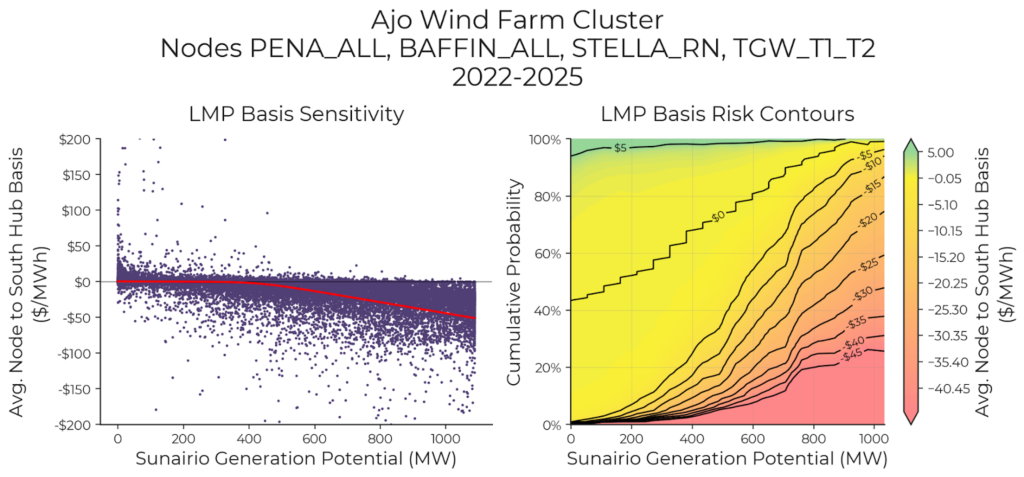
Using Sunairio’s Historical Generation Potential and aligning with three years of historical node and hub LMP data, we can explore the relationship between Generation Potential for this cluster of wind farms and the average node to South hub basis (Figure 6, left). (Note that from 2022 to 2025, the four nodes associated with this cluster of wind farms experience the same real-time LMP in 99.99% of hours.) As the left panel shows, as Generation Potential for that wind farm cluster increases, there is a non-linear shift in the occurrence of more negative local basis.
Traders can visualize this conditional probability of congestion as a surface with Generation Potential (Figure 6, right). Given a Generation Potential of ~900 MW, there is a 90% chance of the LMP basis being less than or equal to -$5, and a 85% chance of it being less than or equal to -$10. For virtuals traders trading into the day ahead market to take on congestion exposure, Sunairio asset-level Generation Potential forecasts are a powerful tool for building optimal bid/offer ladders and accurately quantifying the risk of the resulting trading strategy.
Figure 6. (Left) Sunairio Generation Potential vs. average node basis to South Hub of the five wind farms (2022 to 2025).(Right) Conditional probability of real-time congestion of the nodes associated with the five wind farms.
For Hub Traders: Generation Potential Zonal Aggregations Reveal Macro Signals
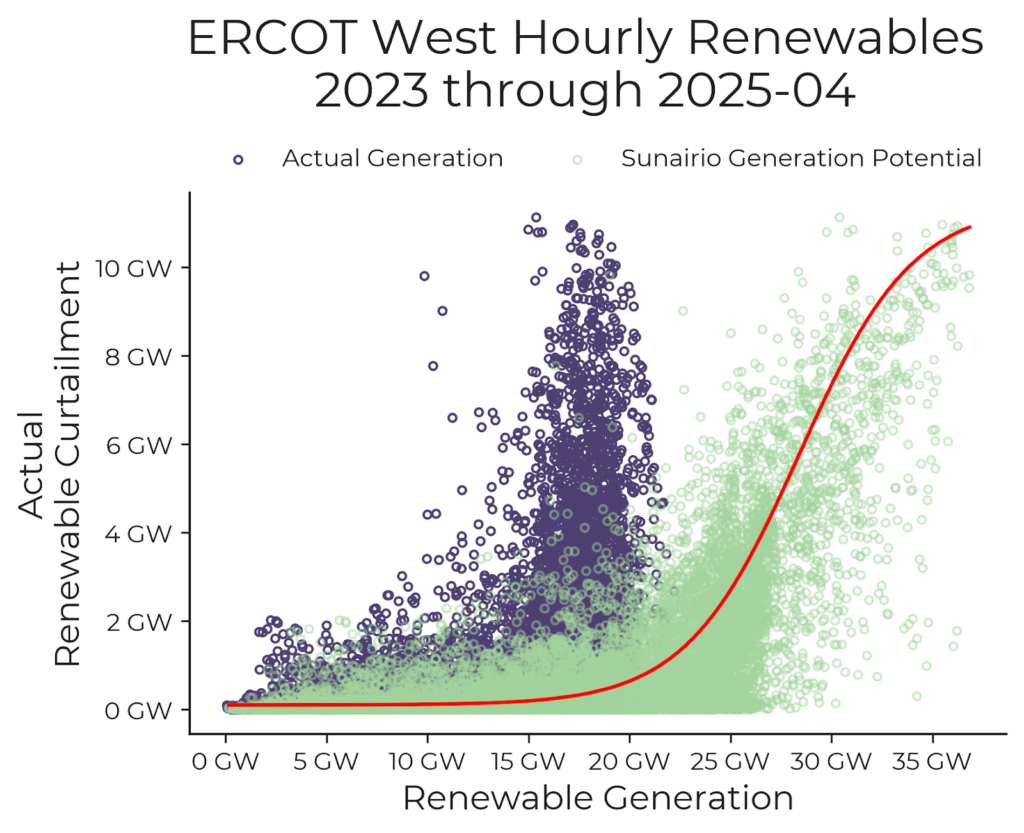
Asset-level generation potential forecasts aren’t just useful for nodal trading. When aggregated up to load zone or ISO-aggregates, they provide a powerful signal of the regional and market-wide curtailment that’s necessary to balance the grid. For example, Figure 7 shows a strong correlation between total ERCOT West Zone Generation Potential and actual West Zone curtailment, which isn’t visible when looking at Actual (post-curtailed) Generation. Predicting this dynamic via generation potential forecasts is critical for managing zonal basis risk.
Figure 7. Total ERCOT West Sunairio Generation Potential provides a strong signal of actual total renewable curtailment in the region while actual (post-curtailed) generation completely obscured the relationship
For Grid Planners: Precision for Planning and Production Cost Modeling
Beyond trading, this granularity is the new baseline for production cost modeling (PCM) and Grid Planning. Our hourly Asset-Level Generation Potential is ideally suited as an input for every individual renewable generation node of SCED models.
Further, Sunairio’s Generation Potential data enable planners to precisely quantify the incremental export capacity required to mitigate regional congestion and validate the specific transmission infrastructure necessary to support it. This shift moves the analytical focus from generalized capacity expansions toward targeted infrastructure investments designed to realize a specific volume of weather-driven energy potential.
See the Signal, Find the Missing MWs
The increasing penetration of intermittent renewables and the rising occurrence of unprecedented weather have rendered historical grid performance a diminishingly reliable proxy for future risk. The integration of Sunairio ONE-powered Generation Potential forecasts at the asset level provides the high-fidelity visibility required to navigate a fundamentally decentralized grid.
By reconciling high-resolution weather modeling – including terrain-induced fluid dynamics and advanced irradiance physics – with Digital Twin asset specifications, Sunairio replaces regional approximations with nodal-specific signals. This granularity is essential for quantifying the supply-side volatility that drives congestion, curtailment, and basis risk in modern power markets.Sunairio ONE represents a shift from reactive grid observation to predictive, physics-based intelligence. Want to see the Generation Potential for your most congested nodes? Contact us to run your portfolio through Sunairio ONE.
ERCOT’s 85 GW load forecast for Winter Storm Fern wasn't just high—it was indefensible
We’re one month removed from the havoc that was Winter Storm Fern. Focusing on its effects in ERCOT, we dug into the weather, grid, and market fundamentals to provide six strategic insights:
1. Five days out, temperature forecasts disagreed about timing and intensity but were reasonably correct about the event low/peak heating period on 1/26. While the peak heating event was relatively extreme, in this particular case it wasn’t much of a short-term surprise. In terms of long-run climatology though, the peak heating event on 1/26 was a P99 event for that calendar day, the week was a P97 and the month was P65.
2. ERCOT appears to have deliberately biased their load forecasts high (incorrectly). Assuming ERCOT was using weather forecast consensus (which was relatively accurate) as the input, we find their 85 GW forecast for 1/26 and 80 GW forecast for 1/27 to be essentially indefensible, falling well outside the range of recent weather-load relationships.
3. ERCOT appears to have deliberately biased wind generation forecasts low (correctly). We know this because their STWPP forecast (representing a P50 level) was below their WGRPP forecast (representing a P20 level). They appear to have manually adjusted the STWPP low but left the WGRPP alone, creating a mathematically impossible scenario.
4. Load in West Texas was significantly affected by icing of oil and gas infrastructure. A large share of load growth in West Texas has been driven by the electrification of oil and gas drilling and processing. When these wells/pipes froze, the associated electrical compression didn’t operate, resulting in exceptionally low load.
5. The market result: a high day-ahead (DA) clear driven by ERCOT’s posturing and then a real-time (RT) fail due to reality and load destruction. ERCOT’s posturing appeared to have the intended effect, supporting a high DA clear with ample reserves to blunt the risk of RT market capacity shortfalls — even in the face of lower than expected wind.
6. Sunairio’s price forecast explained the actual realization and the advanced market fear premium. Looking at our forecast of the 1/26 5x16 North Hub locational marginal pricing (LMP) realizations from the week before, we can see that our expected value was almost spot on, while the long tail to the right explains why some were willing to pay $600+ (because there was a small chance of clearing over $1,000). Note: the mean of our price distribution was at the 80th percentile — far from the median — because of the extreme right skew (risk of high prices).
Sunairio ONE In-depth Part 3: Beyond the Patchwork: Achieving Seamless 15-Year Hourly Ensemble Forecasting
Over the past few weeks, we have explored what makes Sunairio ONE a "next-generation" forecast. In Part 1, we discussed the necessity of a calibrated ensemble that accurately captures extremes. In Part 2, we demonstrated why high spatial and temporal resolution is critical for modeling modern renewable assets like wind and solar. In this final installment, we show that Sunairio ONE provides a unified, seamless outlook from hours to years, eliminating the fragmentation issues that the industry faces today.
The Current Landscape: A Patchwork of Compromises
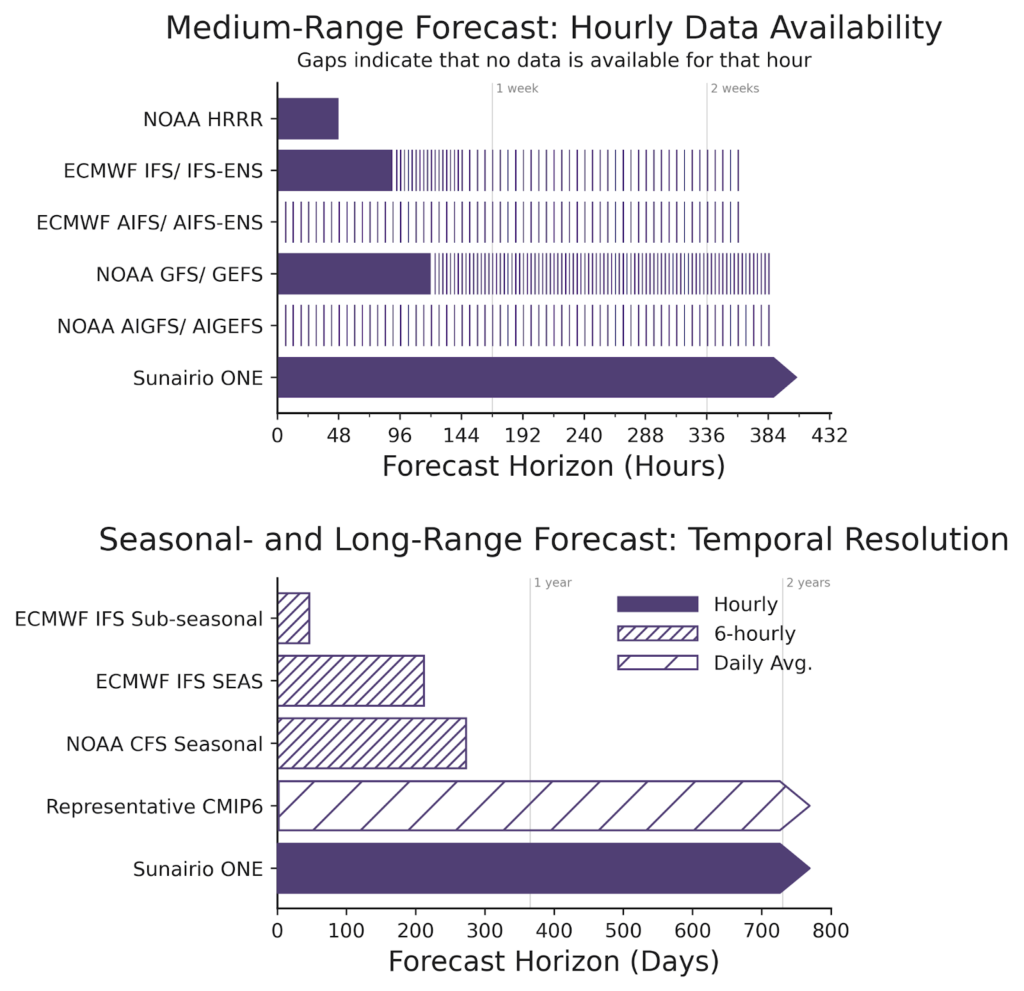
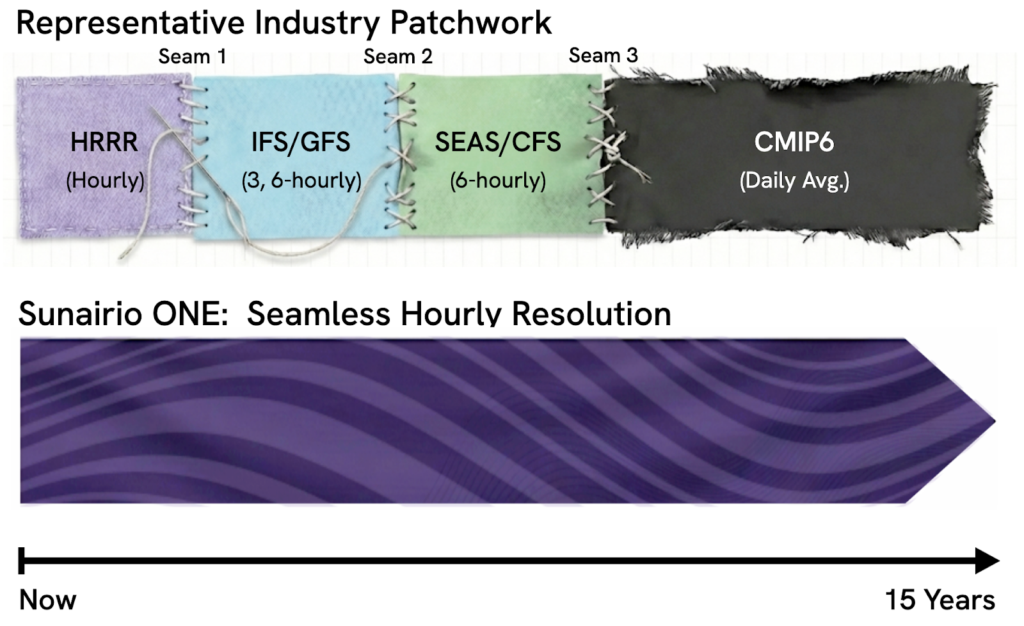
Today, energy traders, grid operators, and other energy professionals have access to a growing collection of public weather forecasts that are each published with differing outlook horizons, temporal resolutions, and refresh schedules.For example, NOAA’s HRRR provides hourly forecasts for the next two days. Other forecasts, such as the GFS or ECMWF’s IFS, stretch to about 2 weeks, but with lower temporal resolution further in the outlook period (see Figure 1, top panel). Seasonal-range forecasts such as the CFS or IFS SEAS look many months into the future, but are low temporal resolution (see Figure 1, bottom panel) and in the case of the SEAS, published only once per month, letting forecasts go stale quickly. While most weather forecasts are updated just four times per day (e.g., 00Z, 06Z, 12Z, and 18Z) or fewer, Sunairio ONE is refreshed each hour using the latest information.
To look beyond 9 months, one must turn to climate models (the current iteration of models are known as CMIP6) instead of weather forecasts, which can be significantly biased, typically provide only vague daily averages, and obscure intraday volatility.
Figure 1. (Top panel) Even within a short 16-day outlook, alternative forecasts provide sparse data with low temporal resolution across days while Sunairio ONE provides dense hourly data without gaps; (Bottom panel) For seasonal or longer outlook periods, only Sunairio ONE provides hourly data.
Thus, in order to build a complete picture of future weather risk– both in the short-term and in long-term planning– energy traders and asset managersneed to stitch together information across multiple sources in a patchwork manner as illustrated in Figure 2. This fragmented approach requires building multiple complex data pipelines, and perhaps more importantly, it makes it challenging to synthesize insights for key operational and planning decisions. Sunairio ONE provides the seamless solution that the industry needs.
Figure 2. The standard industry approach involves stitching together different models with varying resolutions, creating data "seams" and leaving a massive void for long-term planning. Sunairio ONE provides a seamless long-term outlook.
The Sunairio ONE Advantage: The Unbroken Line
Sunairio ONE was designed to eliminate the seams that exist when moving across timescales, providing full continuity and high resolution.
How is it possible to generate a credible hourly ensemble forecast a decade in advance?
It requires bridging the gap between traditional numerical weather prediction (NWP) and long-term climate modeling. Sunairio ONE is not just "extending" a standard weather model until it falls apart. It utilizes a proprietary blend of physics-based modeling and AI-driven calibration.
As detailed in our overview of ENSO-informed climate simulations, our long-range ensembles are constrained by large-scale climate signals, such as El Niño and La Niña cycles. This ensures that the weather patterns generated in years 5, 10, or 15 are physically consistent with the broader climate realities expected during those periods, while still providing the hourly volatility required for asset modeling.
The Business Impact: Strategic Consistency
Moving from a fragmented patchwork to a seamless solution offers more than just technical convenience; it solves fundamental business problems:
Eliminating "Model Basis Risk": When a short-term trading desk uses one model and the term traders use another, the firm risks making operational decisions that contradict a strategic outlook. A unified model ensures everyone is reading from the same book.
Aligning Analytics with Market Contracts: Power markets operate on financial timelines (e.g., balance-of-month (balmo), seasonal (summer/winter), and annual contracts) that frequently collide with the rigid boundaries of standard weather forecasts. Sunairio ONE solves this misalignment by providing an unbroken, 15-year hourly stream.
Streamlined Data Pipelines: Data engineers no longer need to build complex intake systems to parse GRIB files from four different government agencies, normalize the data, and try to stitch it together. Sunairio ONE offers a single API feed and consistent timeseries format.
Accurate Long-Term Valuation: To value an energy asset over its lifecycle, modeling assessments need realistic forward-looking weather assumptions that replicate trends and volatility instead of simple historical averages. Sunairio ONE’s 15-year hourly ensemble captures trends, replicates extremes, and provides the necessary fidelity for accurate long-term financial modeling.
The Future of the Grid is Unified
Over this three-part blog series, we have outlined why the energy transition demands a new class of forecast technology. The grid of the future cannot run on forecasts that fail to see extremes, lack necessary resolution, or fragment after two weeks.
Sunairio ONE delivers unprecedented fidelity at all time scales. It is calibrated, sharp, high-resolution, and, crucially, seamless. It’s time to stop stitching together forecast models and start solving energy challenges with a unified view of the future.To see the difference seamless data can make for your organization, contact us today for a demonstration of the Sunairio ONE 15-year hourly ensemble.
Sunairio ONE In-depth Part 2: Resolution Matters
This is the second blog post in our three-part series that explores key areas where Sunairio’s Omniscale Next-generation Ensemble (ONE) forecast model outperforms traditional solutions. Our first blog post demonstrated that Sunairio ONE was more calibrated, sharp, and extremes-conspicuous than legacy ensemble methods. Here, we show that Sunairio ONE’s high spatial resolution captures local variability of wind speeds better than existing models and demonstrate how that wind speed gradient can translate to a large variation in expected power output.
Introduction
Variable renewable energy assets like utility-scale wind and solar farms experience meaningful fluctuations in power output as local weather conditions change. However, most weather forecasts aren’t generated at a spatial or temporal granularity that’s sufficient to accurately anticipate those dynamics. In the case of wind, for example, detailed topographical features and their resulting phenomena (e.g., terrain-induced waking or speed-up effects) are lost at coarse resolutions1. Sunairio ONE addresses these challenges by providing a high resolution weather forecast, which captures small-scale variability, enabling best-in-class asset-level generation potential forecasts.
Wind farm forecasting best practices
Asset-level wind energy forecasting requires both highly-accurate weather forecasts of mesoscale wind (on the order of a few km) and sophisticated models of wind field dynamics within the wind farm footprint, which are affected by many factors including terrain, vegetation cover, and turbine waking.
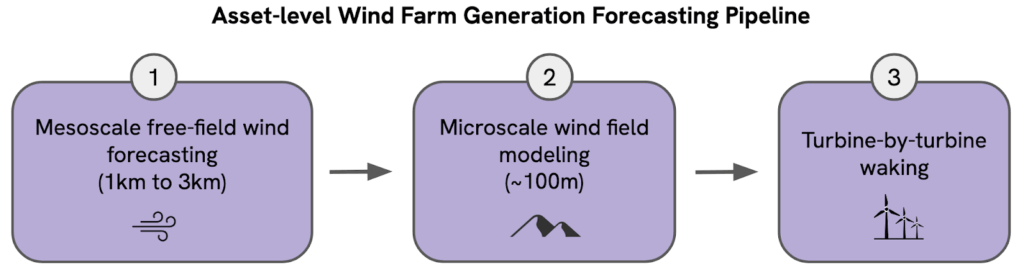
In fact, we find that wind energy modeling best practices dictate separating this problem into three stages: 1) the mesoscale free-field wind2 forecast, 2) the microscale wind field within the wind farm footprint (less than 1km effects usually influenced by terrain), and 3) turbine-by-turbine waking (Figure 1).
Figure 1. Diagram showing three mains steps involved in accurate modeling wind energy at a wind farm.
We are now excited to leverage Sunairio ONE, our high-resolution ensemble weather forecast, to improve mesoscale wind forecasting for asset-level generation.
Existing weather forecasts are too coarse, or fine-but with limited outlook
Surveying the landscape of publicly available weather models that can provide mesoscale free-field wind forecasts shows that none offer truly high spatial and temporal resolution output that extend beyond a few hours (Table 1). Furthermore, Figure 2 helps provide some scale to the current problem, comparing the spatial resolution of Sunairio ONE (at approximately 2km) and the IFS (at approximately 10km) against actual wind farm footprints in ERCOT. Mesoscale forecasting at 10km (like the IFS) vs. 2km may average out important wind gradients that vary over a wind farm and lead to exponential wind generation errors (more on this below).
Additionally, Sunairio ONE forecasts are generated at hourly temporal resolution–critical for energy forecasting applications–for the full forecast period; no other major publicly available forecast model does this. For example, the IFS starts at hourly resolution for the first three to four days but then drops to 3-hourly and 6-hourly steps as it gets further out.
0-90 at 1-hourly 93-144 at 3-hourly 150-360 at 6-hourly
0.1°
~10km
AIFS/AIFS ENS (ECMWF)
15 days
0-360 at 6-hourly
0.25°
~28km
Sunairio ONE
15 years
1-hourly
0.02°
~2km
Table 1. Comparison of forecast models by outlook period, temporal resolution, and spatial resolution.
Figure 2. Zoomed area of map of wind farms in Texas (shaded bounding boxes show footprints of wind turbines at wind farms).
Wind is highly variable across wind farm scales
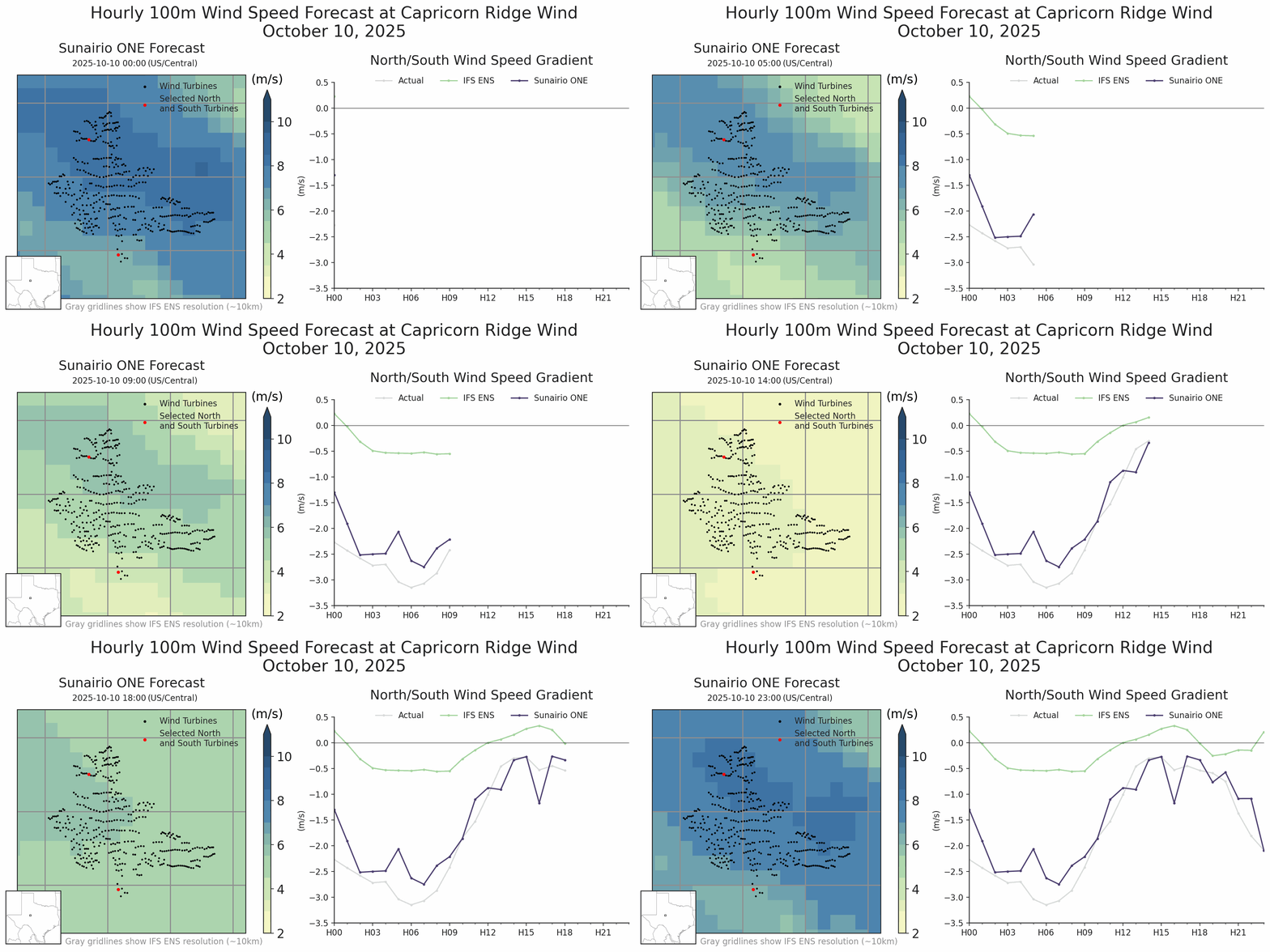
To visualize just how important it is to capture variations in free-field wind forecasts, we analyzed a day of wind forecast performance (three days out) between Sunairio ONE and the IFS across a major ERCOT wind farm, Capricorn Ridge. As Figure 3 shows, the difference between wind speeds at the north end of the farm compared to the south end (turbines marked in red in left panel) were as great as 3 m/s in some hours. While Sunairio ONE successfully forecasted this wind field gradient (right panel), the lower-resolution IFS could not resolve the proper dynamics, instead seeing a fairly uniform wind field.
Figure 3. (Left panel): Map of Sunairio ONE forecasted wind speed across a wind farm in Texas over a 24-hour period; (Right panel): Line plot tracking the wind speed gradient (i.e., difference in wind speeds) from the north side to the south side of the farm compared toSunairio ONE 3-day ahead forecast and IFS ENS 3-day ahead forecast.
Why it all matters: Even seemingly minor weather variations can have outsized impacts in power output
Does a 3 m/s gradient in free-field wind speed over a wind farm really matter? Depending on the absolute wind speed levels, it can matter immensely. Below their rated capacity, wind turbine power output scales cubically with wind speed which causes even seemingly minor variations in wind speed to lead to large differences in generation potential. Turning to Figure 4, we plot an example power curve of a 1.5 MW turbine, which represents the majority of turbines at Capricorn Ridge. A difference of 3 m/s in wind speed can translate to up to a 959 kW delta in power output, or 64% of rated capacity!
Figure 4. Power curve for the 1.5 MW wind turbines that comprise the Capricorn Ridge Farm. 3 m/s wind speed gradients can translate to power differences as large as 959 kW.
Over a wind farm with hundreds of turbines, the impact of modeling wind speeds at a lower resolution on generation potential forecast performance can quickly add up.
Conclusion
Accurately forecasting local wind speeds is essential for creating reliable forecasts of asset-level generation. Sunairio ONE provides 2km spatial resolution, hourly temporal resolution forecasts that are ideally suited to serve as the critical free-field wind forecast step in wind farm generation modeling pipelines.