New Report Validates Sunairio’s Weather and Climate Datasets Can Improve Power Grid Planning

Independent analysis results show Sunairio’s high-resolution historical and forward-looking datasets can match or outperform industry-standard benchmarks, while addressing critical analytical gaps.

BALTIMORE, MD. — 12 November 2026 — Sunairio, pioneer of next-generation grid forecasting software, today announced the publication of an independent technical evaluation conducted by EPRI, an independent, nonprofit energy R&D institute, in partnership with energy supplier Constellation. The study shows that Sunairio’s historical and forward-looking weather and climate datasets can solve key functional gaps for grid planners while broadly matching or outperforming established industry benchmarks across key accuracy and physical realism metrics. 

This study resulted from Sunairio’s participation in EPRI’s Incubatenergy Labs program, which provided the opportunity to conduct a demonstration project evaluating its weather and climate datasets for energy planning applications.

Sunairio’s foundational weather data serves as the backbone intelligence for a comprehensive grid forecasting platform that specializes in replicating extreme event risk for energy traders, power producers, battery energy storage system (BESS) operators, hyperscalers, and demand response (DR) & virtual power plant (VPP) operators. These market participants rely heavily on time-series weather data to model the simultaneous variability between load, renewables, and outage events that drive risks to reliability and profitability. 

To accurately capture correlated variability between load, wind, solar, and market prices, grid planners and energy traders require data satisfying five criteria: 

  1. High spatial resolution
  2. High temporal resolution
  3. Long historical duration
  4. Physical consistency across coincident variables
  5. Forward-looking climate trends 

However, traditional industry-standard weather datasets have routinely forced market participants to select multiple unrelated datasets for specific weather variables while compromising on temporal depth, spatial resolution, or the inclusion of forward-looking climate projections, depending on their application. For example, many grid planning studies in the US have traditionally relied on a seven-year-long wind speed dataset produced only for the years 2007 to 2013, providing a severely limited historical view of wind generation resource risk. 

Sunairio bridges this analytical gap by unifying two proprietary datasets to provide a comprehensive, extensive, continuously updated, high-spatiotemporal resolution historical weather dataset — the historical Sunairio High-resolution Earth Data (SHED; Figure 1) — along with a calibrated, high-resolution, long-range weather forecast ensemble known as Sunairio ONE, which is trained on the SHED. 
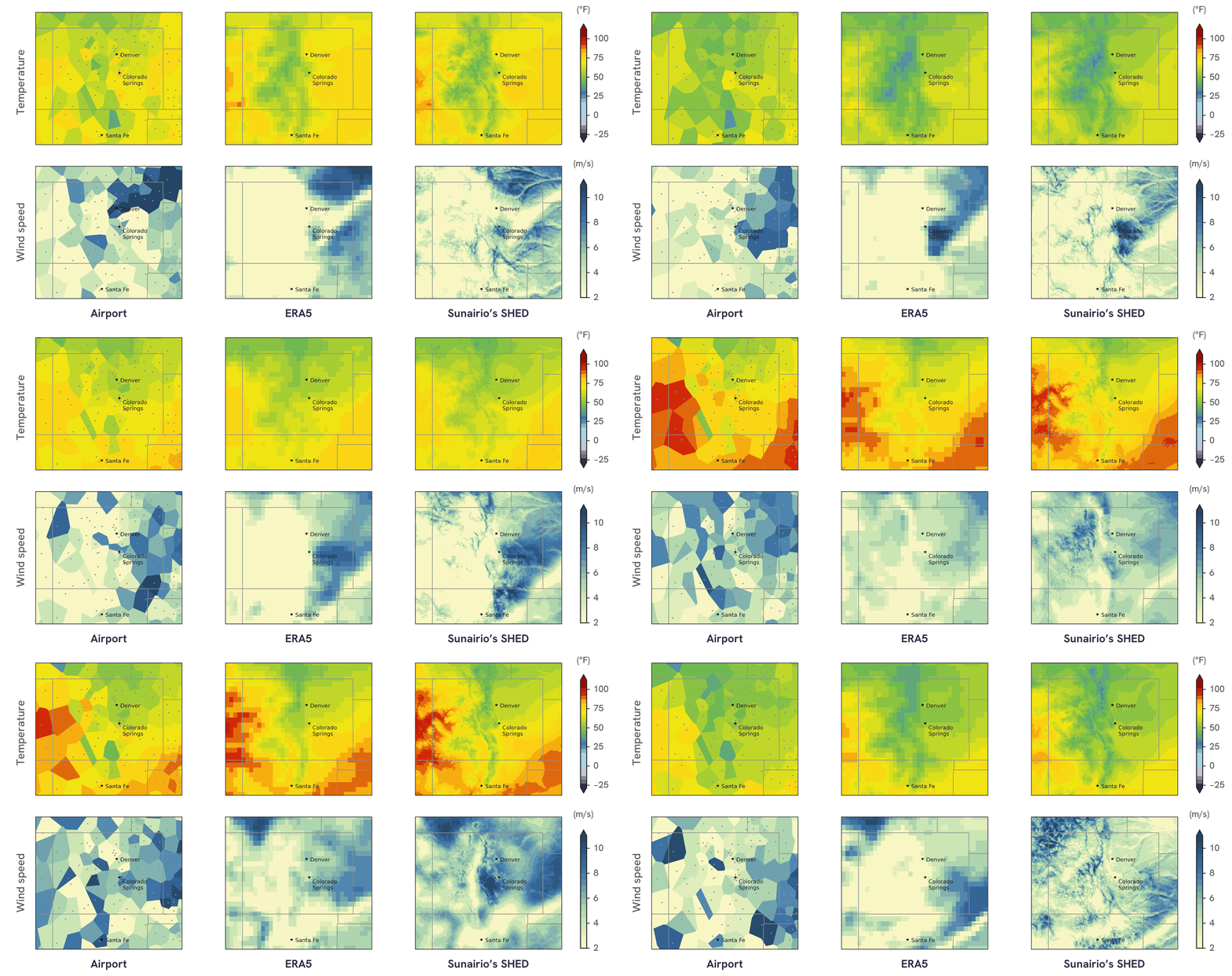
Animated 2m temperature (top) and 10m wind speed (bottom) for Airport ASOS/AWOS observations (left), ERA5 reanalysis (middle), and Sunairio’s SHED dataset (right) over Colorado during a wind ramp event.
Figure 1: Animated 2m temperature (top) and 10m wind speed (bottom) for Airport ASOS/AWOS observations (left), ERA5 reanalysis (middle), and Sunairio’s SHED dataset (right) over Colorado during a wind ramp event.

Together, these tools allow utilities, independent power producers, and traders to quantify a full spectrum of weather risk over long time horizons, instead of relying on static slices of history that can miss extremes and ignore climate trends. As recent weather-driven grid emergencies have demonstrated, anticipating the impact of extreme heat waves, winter storms, and severe droughts in wind or solar is critical for maintaining both reliability and profitability.

Key findings of EPRI evaluation

To quantify how effective the Sunairio data is, EPRI conducted an independent, multi-location evaluation of accuracy and physical realism directly against established public benchmarks. EPRI measured temperature, wind speed, and irradiance performance against public gold-standard datasets across more than 50 locations in the contiguous United States.

The study evaluated Sunairio’s data against three widely used public alternatives: ECMWF’s ERA5, NREL’s WIND Toolkit (WTK), and NREL’s NSRDB. The analysis examined performance across 37 major load centers, 12 tall tower sites, and 15 solar observation sites (SURFRAD/SOLRAD).

Across evaluated metrics — including root mean square error (RMSE), mean absolute error (MAE), correlation, bias, and distributional alignment — Sunairio’s datasets demonstrated performance comparable to or improved over public benchmarks:

The complete technical report, Evaluation of Sunairio High-Resolution Earth Data (SHED) and Sunairio ONE Climate Forecast Ensemble, is available to download free on the EPRI website. 

For additional insights from the report, read Sunairio's blog post, "How the SHED and Sunairio ONE Solve the Power Sector's Biggest Analytical Blind Spot,” here.

And finally, to learn more about Sunairio’s climate-informed datasets, schedule a demonstration, or discuss integration into your organization's resource adequacy or commercial trading models, visit sunairio.com or contact the Sunairio team at info@sunairio.com.

###

About Sunairio

Sunairio is the pioneer of award-winning, next-generation grid forecasting software — the first forecasting platform to provide integrated energy, weather, climate, and market insights. Sunairio helps energy traders, grid operators, and asset managers make better commercial decisions in the face of increasing grid variability and extreme event risks. Sunairio and Sunairio ONE have received recognition from the National Science Foundation, American Clean Power, and EPRI.

Media Contacts

Josh Petri and Logan Varsano

Inflection Point Agency for Sunairio
josh@inflectionpointagency.com 

logan@inflectionpointagency.com

How the SHED and Sunairio ONE Solve the Power Sector’s Biggest Analytical Blind Spot

Energy traders, power producers, and grid planners rely heavily on time-series weather data to model the simultaneous, correlated variability between load spikes, renewable generation variability, and generator outage events. As recent weather-driven grid emergencies have starkly demonstrated — from Winter Storm Uri in Texas to extreme heatwaves in California — anticipating the impact of severe weather on wind, solar, and load is no longer optional — it is the defining challenge of modern energy management. 

However, a critical analytical blind spot has persisted: the industry has lacked a single, comprehensive weather dataset capable of accurately representing both long-run variability, historical extremes, and future climate realities.

That is changing. A recently published independent technical evaluation by the Electric Power Research Institute (EPRI) — conducted in partnership with energy supplier Constellation through the EPRI Incubatenergy Labs (IEL) program — validates that Sunairio’s historical and forward-looking datasets successfully address this functional gap, broadly matching or outperforming established industry benchmarks.

Here is a closer look at the industry data problem, how Sunairio solves it, and what the EPRI evaluation uncovered.

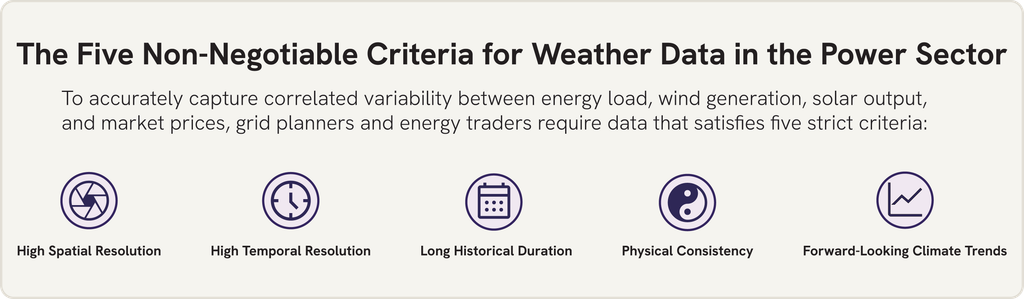
The Five Non-Negotiable Criteria for Weather Data in the Power Sector

To accurately capture correlated variability between energy load, wind generation, solar output, and market prices, grid planners and energy traders require data that satisfies five strict criteria:

  1. High Spatial Resolution: Data must be highly localized (3 km or less) to capture the unique microclimates of individual wind farms, solar arrays, and population centers.
  2. High Temporal Resolution: Hourly or sub-hourly data is required to model sudden ramps in solar and wind production or steep drops in temperature.
  3. Long Historical Duration: A minimum 20-year timespan is necessary to capture natural, multi-decadal weather variability and rare tail events.
  4. Physical Consistency: Variables like temperature, wind speed, irradiance, and humidity must be physically consistent with one another at any given time to accurately model complex joint extremes (e.g., high heat combined with low wind).
  5. Forward-Looking Climate Trends: Because the climate is non-stationary, historical data alone is no longer sufficient; models must capture projected shifts in extreme weather frequencies and baseline distributional changes.

For years, traditional industry-standard weather datasets have forced market participants to compromise. Analysts routinely have to stitch together multiple unrelated datasets for specific weather variables, sacrificing either temporal depth, spatial resolution, or the inclusion of forward-looking climate projections.

Consider a common real-world example: Most grid planning studies in the U.S. have traditionally relied on the National Renewable Energy Laboratory’s (NREL) WIND Toolkit. While excellent in resolution, it is only a seven-year dataset spanning 2007 to 2013. Relying on a seven-year slice of history provides a severely limited view of wind generation resource risk, completely missing cyclical weather patterns and recent extreme events.

Sunairio’s Data: Unifying the Past and the Future

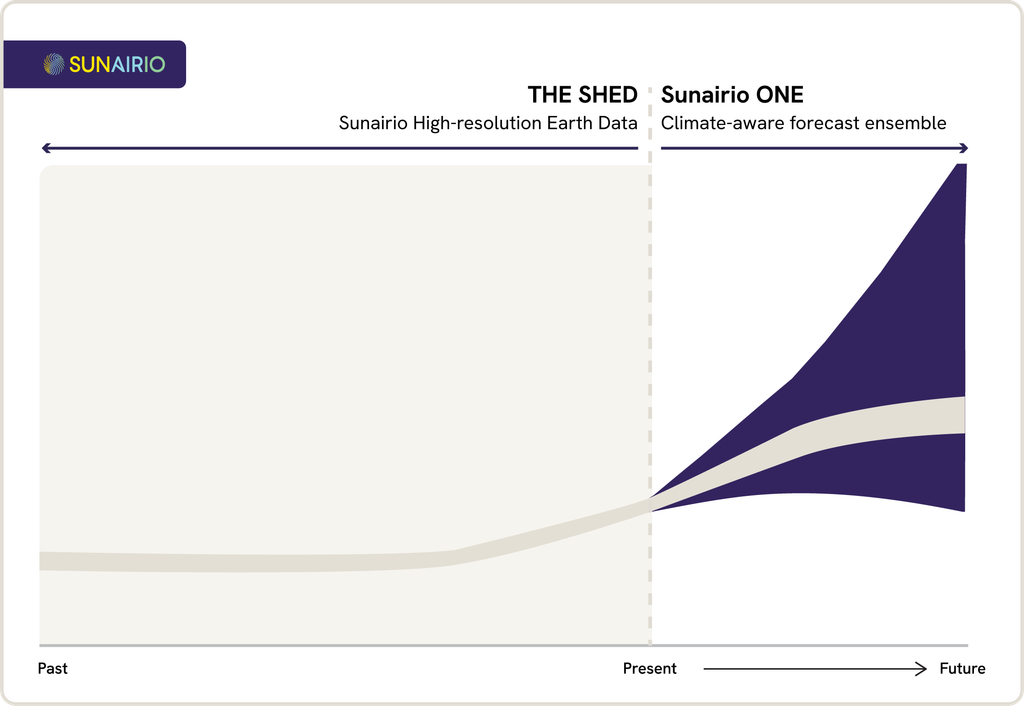
Sunairio bridges this persistent analytical gap by unifying two proprietary datasets to provide a comprehensive, continuously updated, high-spatiotemporal resolution solution.

Together, these tools act as the foundational intelligence for Sunairio’s next-generation grid forecasting platform. By utilizing SHED and Sunairio ONE, utilities, independent power producers, battery energy storage system (BESS) operators, and virtual power plant (VPP) operators can quantify a full spectrum of weather risk over long time horizons. Instead of relying on static slices of history that ignore climate trends, asset managers can stress-test their portfolios against realistic, climate-adjusted future extremes.

Inside the EPRI Evaluation Scope

To quantify exactly how effective the Sunairio data is, EPRI conducted an independent, multi-location evaluation of accuracy and physical realism. EPRI measured Sunairio's temperature, wind speed, and irradiance performance directly against public gold-standard datasets across more than 50 locations in the contiguous United States.

The public datasets used as benchmarks included:

The analysis evaluated performance across 37 major load centers, 12 tall tower sites (for hub-height wind speeds), and 15 SURFRAD/SOLRAD observation sites.

Key Results: Superior Historical Accuracy (SHED)

Because historical data can be compared directly to actual observations, EPRI evaluated the SHED based on its objective accuracy, looking at metrics like Mean Absolute Error (MAE), root mean square error (RMSE), correlation, and bias.

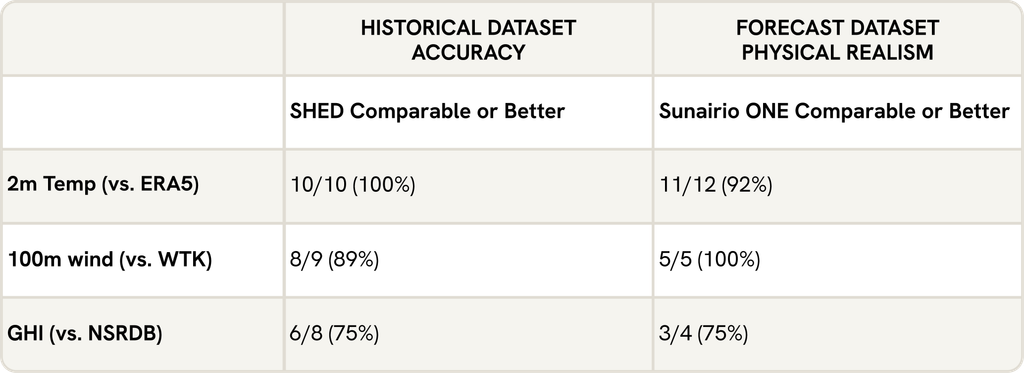
Across these evaluated metrics, Sunairio’s historical data demonstrated performance that was comparable to, or explicitly improved over the public benchmarks:

Key Results: Advanced Physical Realism (Sunairio ONE)

Because forward-looking ensembles simulate the future, they cannot be validated against observed reality. Instead, EPRI evaluated Sunairio ONE based on its "physical realism" — its ability to accurately represent the relative frequency and magnitude of hazards, the temporal characteristics of volatility, and its alignment with expected long-term climate trends.

As with any rigorous scientific evaluation, the study also noted specific areas for continued refinement. For example, EPRI noted that while Sunairio ONE excels at daily wind variance, ERA5 remains slightly better at capturing synoptic-scale (multi-day) wind variance. Additionally, refining low-wind tail event representations remains a focus for future iterations, ensuring that the highest-impact resource adequacy risks are flawlessly modeled.

Beyond Grid Planning: Training the Next Generation of AI Weather Models

While resource adequacy and investment planning are critical applications for Sunairio’s datasets, the implications of SHED extend much further—specifically into the rapidly evolving field of artificial intelligence. Today, almost all of the world's leading AI weather models are trained on ERA5 data. While ERA5 is a powerful global reanalysis tool, its spatial resolution is fundamentally limited to approximately 30 kilometers. This bottleneck forces AI models to learn from smoothed, generalized historical data, restricting their ability to forecast highly localized weather phenomena, coastal dynamics, or complex terrain effects with precision.

SHED offers a groundbreaking alternative for AI development by providing a unified training dataset at 100 times the spatial resolution of ERA5. By training on SHED’s 2-kilometer, hourly historical data, meteorologists and data scientists can teach neural networks to recognize complex, highly localized atmospheric patterns that 30-kilometer grids completely miss. This massive upgrade in training data fidelity paves the way for a new class of ultra-high-resolution AI weather forecasts, capable of delivering the hyper-local accuracy required for tomorrow's energy grids and financial markets.

Stop Guessing. Start Planning with Confidence.

The EPRI evaluation provides independent validation of what our partners already know: you no longer have to compromise on your weather and climate data.

Sunairio launches Emergency Event Forecasts to better anticipate power grid stress

More frequent extreme weather events, rapid load growth, and evolving generation mixes have made grid emergencies more common; Sunairio’s new offering allows market participants to anticipate those episodes in advance with greater precision. 

BALTIMORE, MD. — October 22, 2026 — Sunairio, pioneer of next-generation grid forecasting software, today announced the launch of first-of-a-kind Emergency Event Forecasts: hourly probabilities of power grid emergencies — starting with the PJM and ERCOT regional transmission organizations (RTOs) — to help traders, asset managers, flexibility providers, and investors understand how to manage an increasingly strained system. 

As extreme weather, rapid load growth, and shifting generation mixes push power grids to their operational limits, grid emergencies are moving from rare anomalies to frequent market drivers. Sunairio’s new forecasting capability equips market participants with probabilistic foresight to anticipate the tightest conditions hours, days, and even years in advance.

Navigating the "New Normal" of Grid Stress

When electricity generation reserves fall dangerously low relative to required levels set by NERC, grid operators declare an Energy Emergency Alert (EEA). These alerts can trigger sudden out-of-market interventions, manual load curtailments (brownouts or blackouts), and severe price spikes — with real-time energy prices often hitting or exceeding system offer caps.

While reserve-shortage-driven EEA events used to be rare — averaging just one per year across the US’s Eastern Interconnection over the past decade — 2026 has marked a dramatic turning point. Already this year, Eastern RTOs have experienced five episodes requiring mandatory load management. 

In PJM specifically, RTO-wide alerts were declared during record-setting summer heatwaves in July and again during autumn generator outage season in September and October. Each time, large industrial and data center customers were warned they could face direct disconnection from the grid.

Conventional market price and load forecasting models, which assume smoothly varying behavior, struggle to predict the sudden and extreme shifts that happen during grid emergencies. Sunairio’s Emergency Event Forecasts bridge this critical gap by predicting the exact conditions that trigger emergency declarations before they occur. 

“Just last week, PJM experienced another grid emergency that triggered demand response, which was a surprise to many. But our models predicted that specific timeframe as having the highest expected grid stress risk in the entire quarter several months ago,” said Rob Cirincione, CEO of Sunairio. 

Cirincione went on to share, "What we’ve witnessed across major power markets this year is a clear warning sign. As grid stress continues to intensify, providing clear, probabilistic visibility into these high-stakes hours gives power sector stakeholders the actionable foresight needed to ensure reliability, hedge financial exposure, and make smarter capital investments."

Powered by Sunairio’s Grid Stress Index and Sunairio ONE

At the core of Sunairio’s Emergency Event Forecasts is the company’s proprietary Grid Stress Index (GSI), which measures dispatchable capacity utilization — how much of the online dispatchable generation fleet is required to meet system load. During critical hours, GSI moves in lockstep with operating reserves. 

Sunairio’s GSI forecasts are powered by the in-house Sunairio ONE ensemble, a next-generation forecast that specializes in replicating extreme events,  generating 1,000 realistic hourly GSI forecast paths which are translated into precise, calibrated hourly probabilities (0–100%) for every level of the emergency ladder.

Tailored Solutions Across Energy Sector Stakeholders

Emergency Event Forecasts deliver critical operational and financial value across a wide range of industry players:

Currently available for PJM and ERCOT, Sunairio’s Emergency Event Forecasts will soon expand to cover all US grid regions. 

For a deeper dive on Sunairio’s newest tool and an analysis on recent grid emergency trends, read the technical blog post here. 

To request a product demonstration or learn how Emergency Event Forecasts can be integrated into your workflow, contact the Sunairio team at info@sunairio.com or visit www.sunairio.com.

###

About Sunairio
Sunairio is the pioneer of award-winning, next-generation grid forecasting software — the first forecasting platform to provide integrated energy, weather, climate, and market insights. Sunairio helps energy traders, grid operators, and asset managers make better commercial decisions in the face of increasing grid variability and extreme event risks. Sunairio and Sunairio ONE have received recognition from the National Science Foundation, American Clean Power, and EPRI. For more information, please visit sunairio.com.  

Media Contact
Logan Varsano
Inflection Point Agency for Sunairio
logan@inflectionpointagency.com 

Sunairio Announces Grid Status Data Partnership to Streamline Power Trading and Grid Risk Mitigation

Energy market participants can now seamlessly track forecast performance, backtest strategies, and navigate grid volatility in one ecosystem.

Baltimore, Md. — July 28, 2026 — Sunairio, pioneer of next-generation grid forecasting software, today announced its newest data partner, power grid data and analytics firm Grid Status. Grid Status, which monitors the real-time status of the US electric grid, will now provide independent system operator (ISO) data for Sunairio’s forecasting platform, ensuring up-to-date, complete, and reliable data for critical decision making.  

Thanks to the new partnership, Sunairio customers can now contextualize and validate Sunairio grid forecasts against official ISO data at scale within a single platform. This enables users to easily monitor energy forecast performance, perform trading strategy backtests, and investigate power market fundamentals through a single user interface and API.

The new capabilities provided by the partnership will better equip users to navigate an increasingly challenging weather and energy landscape. Today’s confluence of more frequent weather extremes, higher penetration of renewable energy, and increasing electricity demand have created the perfect storm for the power grid. Clear signals of power grid dynamics are vital for every company exposed to power market risk.   

“Any serious forecast consumer needs high-volume and high-quality access to public forecast benchmarks and historical realizations in order to develop commercial strategies. Our new partnership with Grid Status allows Sunairo customers to do just that for all of our grid forecasts within ISO regions,” said Sunairio founder and CEO Rob Cirincione.  

Cirincione went on to explain, “The importance of quality data to serve as ground truth really can’t be underestimated. Sunairio customers can now build end-to-end workflows that train, test, and validate strategies in a single platform that leverages a trusted ISO data provider. No more combining data from different sources, and no more worrying that the historical prices aren’t correct.”

To learn more or to contact the Sunairio team, please visit sunairio.com or email info@sunairio.com. 

###

About Sunairio

Founded in 2020, Sunairio is the pioneer of award-winning, next-generation grid forecasting software that’s the first to provide integrated energy, weather, and climate insights. Sunairio helps energy traders, grid operators, utility-scale asset developers, and VPP and demand response aggregators make better commercial decisions in the face of increasing grid variability and extreme event risks. Sunairio and Sunairio ONE have received recognition from the NSF, ACP, and EPRI. For more information, please visit sunairio.com. 

Media Contact

Nikki Arnone

Inflection Point Agency for Sunairio
nikki@inflectionpointagency.com

Sunairio unveils ONE, a next-gen grid forecast model with unprecedented fidelity at all time scales

Sunairio ONE captures 97% of extreme events that traditional forecasts miss, providing critical intelligence for grid reliability, power systems planning, and energy markets

Baltimore, MD. — October 16, 2025 — Sunairio, pioneer of next-generation grid forecasting software that provides critical weather and energy insights, announced today that it has launched Sunairio ONE (an Omniscale Next-generation Ensemble). Sunairio ONE now powers the company’s award-winning software for modern energy risk management.

Anticipating granular grid risk today is a daunting task that’s frustrated by a disjointed and inadequate technology landscape. Conventional weather forecasts are complex and slow, limiting their usefulness to modeling near-term events over relatively large areas — with forecast scenarios that misrepresent the chance of extremes. Longer-term forecasts are so inaccurate that the meteorological agencies themselves warn against using the data directly, forcing the industry to rely on historical analogues instead. And the new AI weather forecasts are unfortunately linked to these problems because they train off the same old data. 

Sunairio ONE makes these approaches obsolete.

“We built Sunairio ONE from the ground up to solve these challenges, enabling unparalleled resolution, accuracy, and correct probabilities, complete with seamless coverage for the next hour, the next 15 years — and anywhere in between,” said Rob Cirincione, CEO, Sunairio.. “The key is our unique data — Sunairio ONE is trained on the Sunairio High-resolution Earth Dataset (the SHED), our proprietary, high-resolution historical weather data archive that’s purpose-built to replicate granular risks for the modern grid.”  

Sunairio started with the industry’s benchmark historical weather data, leveraged machine learning to sharpen resolution by 100x, then trained ONE on that data while incorporating changing climate fundamentals. Sunairio ONE generates 1,000-member hourly ensembles compared to traditional methods that stop at 50. The result is unprecedented forecast fidelity for load, renewables, and grid stress across all time scales.

“Alternative forecast methods rarely issue more than 50 forecast scenarios, preventing users from seeing the make-or-break events,” Cirincione explained. “Imagine if I told you there was a 1-in-50 chance of winning the lottery, except you don’t win the lottery, you black out the power grid or bankrupt your company. That’s the risk we’re taking with these limited forecasts.”

“More recently, there’s been a burst of new AI-powered weather forecasts, but what often gets overlooked is that these AI models are only as good as the data they’re trained on — and these models have all been trained on the same public, relatively low-resolution archive,” continued Cirincione. “That means they’re all susceptible to missing the same events — especially extreme events — which are critical in modern power grids where just 1% of hours account for 30% of grid stress.”

A larger forecast ensemble also improves accuracy. For example, compared to grid-level forecasts provided by ISO operator ERCOT, Sunairio’s hourly wind and solar forecasts are up to 20% more accurate on average while capturing the true risk of forecast misses and unprecedented extremes in the ensemble distribution.

Sunairio ONE is an evolution of the company’s award-winning, long-term generative forecast technology — previously recognized by the National Science Foundation, American Clean Power Association, and EPRI. The company’s high-resolution, large-ensemble approach to forecasting now spans both seasonal and climate scales (from 15 days to 15 years) as well as shorter-term 1- to 15-day forecasts.

"No other solution gives us weather and energy forecasts from a 1,000-member ensemble and continuously tracks changes to load growth and infrastructure buildout," said Josh Henson, Vice President, Wholesale Trading, Constellation. “We’ve been pleased with Sunairio as a platform to model probabilistic weather and energy risks for longer-term power markets. Sunairio ONE provides those same insights for short-term markets enabling better business decision-making that benefits our customers.”

Sunairio ONE forecasts support actionable intelligence for reliable planning across power markets and utility operations. It is designed to support a range of use cases, including:

“Some of the greatest risks to power grids are hiding in plain sight. They don’t always look like hurricanes, which makes them more insidious. Increasingly, they look more like unusual combinations of weather that increase demand while reducing renewables output: heat that lingers past twilight or polar vortex cold snaps that arrive with calm winds,” said Raiden Hasegewa, PhD, Director of Data Science, Sunairio. “By combining weather and energy in a sophisticated forecast model, we’re giving companies insight they can’t get anywhere else.”

All of Sunairio’s energy and market models built on top of Sunairio ONE automatically update and retrain continuously, keeping pace with fast-moving fundamentals. For more information, please visit sunairio.com or email info@sunairio.com.

###

About Sunairio
Founded in 2020, Sunairio is the pioneer of award-winning, next-generation grid forecasting software that’s the first to provide integrated energy, weather, and climate insights. Sunairio helps energy traders, grid operators, utility-scale asset developers, and VPP and demand response aggregators make better commercial decisions in the face of increasing grid variability and extreme event risks. Sunairio and Sunairio ONE have received recognition from the NSF, ACP, and EPRI. For more information, please visit sunairio.com.

Media Contact
Nikki Arnone, Inflection Point Agency for Sunairio
nikki@inflectionpointagency.com