
Energy traders, power producers, and grid planners rely heavily on time-series weather data to model the simultaneous, correlated variability between load spikes, renewable generation variability, and generator outage events. As recent weather-driven grid emergencies have starkly demonstrated — from Winter Storm Uri in Texas to extreme heatwaves in California — anticipating the impact of severe weather on wind, solar, and load is no longer optional — it is the defining challenge of modern energy management.
However, a critical analytical blind spot has persisted: the industry has lacked a single, comprehensive weather dataset capable of accurately representing both long-run variability, historical extremes, and future climate realities.
That is changing. A recently published independent technical evaluation by the Electric Power Research Institute (EPRI) — conducted in partnership with energy supplier Constellation through the EPRI Incubatenergy Labs (IEL) program — validates that Sunairio’s historical and forward-looking datasets successfully address this functional gap, broadly matching or outperforming established industry benchmarks.
Here is a closer look at the industry data problem, how Sunairio solves it, and what the EPRI evaluation uncovered.
To accurately capture correlated variability between energy load, wind generation, solar output, and market prices, grid planners and energy traders require data that satisfies five strict criteria:
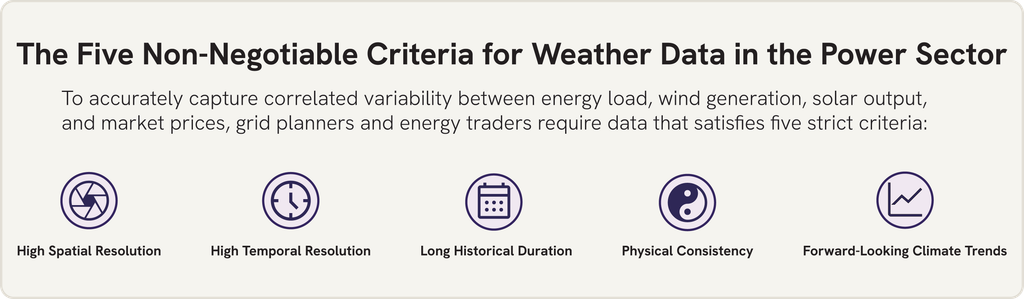
For years, traditional industry-standard weather datasets have forced market participants to compromise. Analysts routinely have to stitch together multiple unrelated datasets for specific weather variables, sacrificing either temporal depth, spatial resolution, or the inclusion of forward-looking climate projections.
Consider a common real-world example: Most grid planning studies in the U.S. have traditionally relied on the National Renewable Energy Laboratory’s (NREL) WIND Toolkit. While excellent in resolution, it is only a seven-year dataset spanning 2007 to 2013. Relying on a seven-year slice of history provides a severely limited view of wind generation resource risk, completely missing cyclical weather patterns and recent extreme events.
Sunairio bridges this persistent analytical gap by unifying two proprietary datasets to provide a comprehensive, continuously updated, high-spatiotemporal resolution solution.
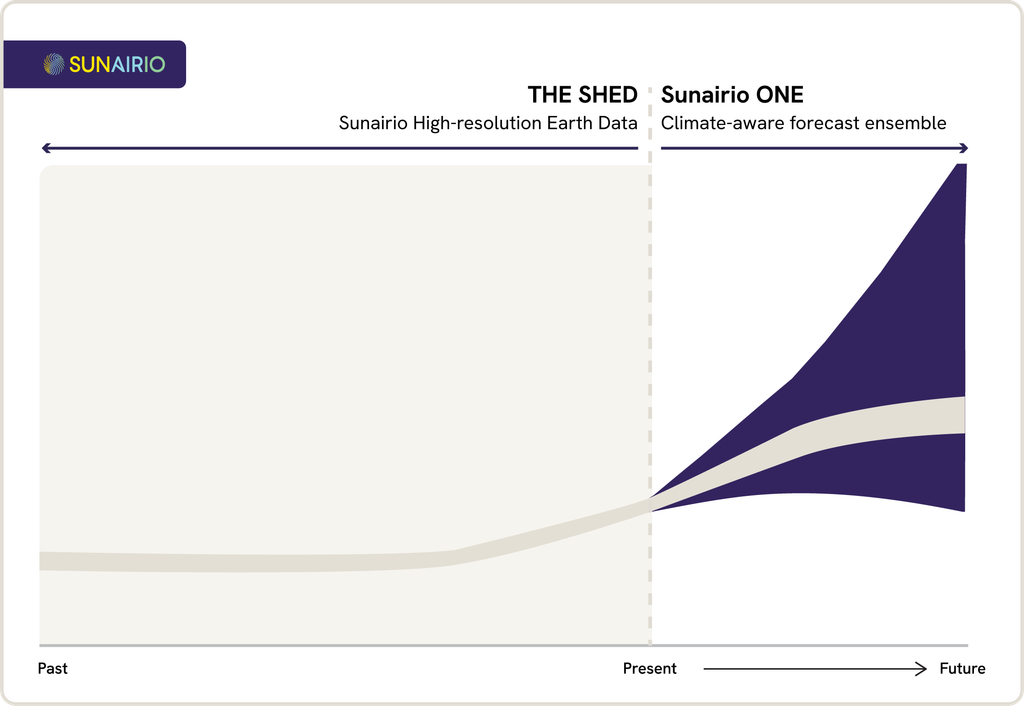
Together, these tools act as the foundational intelligence for Sunairio’s next-generation grid forecasting platform. By utilizing SHED and Sunairio ONE, utilities, independent power producers, battery energy storage system (BESS) operators, and virtual power plant (VPP) operators can quantify a full spectrum of weather risk over long time horizons. Instead of relying on static slices of history that ignore climate trends, asset managers can stress-test their portfolios against realistic, climate-adjusted future extremes.
To quantify exactly how effective the Sunairio data is, EPRI conducted an independent, multi-location evaluation of accuracy and physical realism. EPRI measured Sunairio's temperature, wind speed, and irradiance performance directly against public gold-standard datasets across more than 50 locations in the contiguous United States.
The public datasets used as benchmarks included:
The analysis evaluated performance across 37 major load centers, 12 tall tower sites (for hub-height wind speeds), and 15 SURFRAD/SOLRAD observation sites.
Because historical data can be compared directly to actual observations, EPRI evaluated the SHED based on its objective accuracy, looking at metrics like Mean Absolute Error (MAE), root mean square error (RMSE), correlation, and bias.
Across these evaluated metrics, Sunairio’s historical data demonstrated performance that was comparable to, or explicitly improved over the public benchmarks:
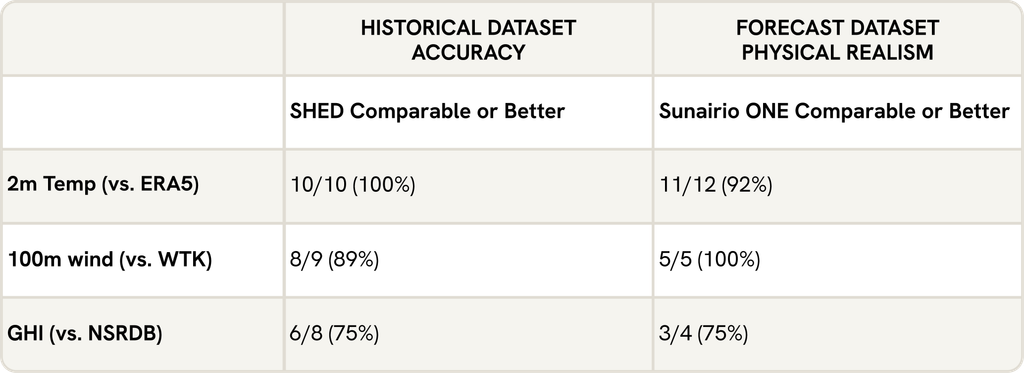
Because forward-looking ensembles simulate the future, they cannot be validated against observed reality. Instead, EPRI evaluated Sunairio ONE based on its "physical realism" — its ability to accurately represent the relative frequency and magnitude of hazards, the temporal characteristics of volatility, and its alignment with expected long-term climate trends.
As with any rigorous scientific evaluation, the study also noted specific areas for continued refinement. For example, EPRI noted that while Sunairio ONE excels at daily wind variance, ERA5 remains slightly better at capturing synoptic-scale (multi-day) wind variance. Additionally, refining low-wind tail event representations remains a focus for future iterations, ensuring that the highest-impact resource adequacy risks are flawlessly modeled.
While resource adequacy and investment planning are critical applications for Sunairio’s datasets, the implications of SHED extend much further—specifically into the rapidly evolving field of artificial intelligence. Today, almost all of the world's leading AI weather models are trained on ERA5 data. While ERA5 is a powerful global reanalysis tool, its spatial resolution is fundamentally limited to approximately 30 kilometers. This bottleneck forces AI models to learn from smoothed, generalized historical data, restricting their ability to forecast highly localized weather phenomena, coastal dynamics, or complex terrain effects with precision.
SHED offers a groundbreaking alternative for AI development by providing a unified training dataset at 100 times the spatial resolution of ERA5. By training on SHED’s 2-kilometer, hourly historical data, meteorologists and data scientists can teach neural networks to recognize complex, highly localized atmospheric patterns that 30-kilometer grids completely miss. This massive upgrade in training data fidelity paves the way for a new class of ultra-high-resolution AI weather forecasts, capable of delivering the hyper-local accuracy required for tomorrow's energy grids and financial markets.
The EPRI evaluation provides independent validation of what our partners already know: you no longer have to compromise on your weather and climate data.
